Year: 2011

  • The Federal Election 2011 – What Does it Mean for Us?

    In case you have not already heard, Canadians are in federal election mode. How did Canada get to the place where it will have its fourth federal election in only 7 years?  It is because the Conservative government fell on March 27, 2011, after a non-confidence vote against them won by156-145 votes. The reason why a motion of non-confidence was brought forward in the first place was because the Speaker of the House, Peter Milliken, found both the Conservative government and one of its Ministers to be in contempt of Parliament for withholding information and misleading the Parliament. http://www.theglobeandmail.com/news/politics/parties-set-for-4th-federal-election-in-7-years/article1954357/ Specifically, the Speaker made two key rulings about the Conservative government’s behaviour which is no surprise to the rest of us, given their highly questionable actions throughout their time as minority government. The first ruling dealt with Bev Oda, the Minister for International Cooperation who failed to disclose her role in the decision to cut funding to Kairos. http://www.nationalpost.com/news/canada/politics/Parliament+waits+Speakers+rulings+Conservatives/4411388/story.html He held that Oda breached her Parliamentary privilege – i.e. she is accused of lying about the decision. First she said that her bureaucrats had denied the funding, then it came to light that they had in fact approved it, but an unknown “someone” had scribbled “not” on the document, then she says she ordered the person to insert the word. It is all very convoluted and confusing, but the moral of the story is – she was not honest with Parliament. The second ruling was against the Conservative government generally. This involved the allegation that the Conservatives were not being honest about the actual costs of its tough on crime legislation and plans to build prisons, its purchase of fighter jets and corporate tax breaks. Despite requests for the actual costing information, the Conservatives refused to disclose them. Therefore, the Speaker ruled that the opposition could continue its investigation of the Conservatives before committee because: “There is no doubt that an order to produce documents is not being fully complied with and this is a serious matter that goes to the House’s undoubted role in holding the government to account.” http://www.thestar.com/news/canada/article/951327–conservatives-ruled-in-contempt-of-parliament They government fell because they were never about the people and were only in it for themselves. They also fell because they are dishonest – which is the biggest crime as far as Canadian citizens are concerned.

    Even our counterparts internationally have commented that Canada is losing its sense of democracy, and very few Canadians seem to be upset about it. One particular article from Australia argues that Canadians are sitting back watching democracy be eroded, while people in other countries are willing to die for their freedoms. http://www.theaustralian.com.au/news/world/canada-watches-its-democracy-erode/story-e6frg6ux-1226030310248 Some commentators are even arguing that Harper should not even be allowed to run in this election because his government was found in contempt of Parliament and was thrown out by a vote of non-confidence. Makes me wonder if Oda will be campaigning along with the rest of the rejected Conservatives? http://presscore.ca/2011/?p=1980 Is it just me, or does anyone else see the utter hypocrisy of the Conservatives? Remember how Senator Brazeau implied that First Nations leaders are all corrupt, that First Nations were hubs of illegal activity and another conservative MP introduced Bill C-575 asking for accountability? That is rich given that the conservatives have been found in contempt and thrown out of Parliament.
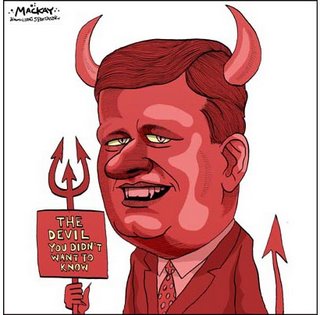
    Or how about Harper who says one thing (never appoint people to Senate without elections) and does another to suit his own political needs (appoint people like Brazeau to Senate). http://www.peterboroughexaminer.com/ArticleDisplay.aspx?archive=true&e=1347743 Or how about when they take a court of appeal case like McIvor, and draft limited and discriminatory legislation to respond to it, but when the federal court of appeal finds against the conservatives (for the in and out scheme), they dismiss it as an “administrative dispute”. http://www.winnipegfreepress.com/canada/breakingnews/former-tory-mps-speak-out-against-conservative-in-and-out-scheme-117368283.html?path=/canada/breakingnews&id=117368283&sortBy=rank It is almost like Harper and his Conservatives don’t live in reality – like they actually believe that “government” is really just made up of the few who sit in Cabinet. Let’s just pretend that none of this non-confidence stuff matters. Let’s look at the Conservative’s “honesty” record to date: (1) Former Minister of International Affairs, Maxime Bernier, resigns over “scandal” related to his leaving security-sensitive documents at his girlfriend’s house – a woman with former connections to the “biker underworld”; http://www.ctv.ca/CTVNews/Specials/20080527/bernier_history_080527/ (2) Former Minister of State for the Status of Women, Helena Guergis, resigned and her file referred to the RCMP after concerns related to her husband Rahim Jaffer using her office to peddle influence with the government. You will recall her husband had been charged with drunk driving and cocaine possession, while Guergis herself was accused of being belligerent to airline staff and using her staffers to flood editorials. http://www.thestar.com/article/792861 (3) MP Pierre Poilievre criticizes the residential school settlement as not being “value for money” on the same day that Harper makes the apology in Parliament. http://www2.macleans.ca/2008/06/11/pierre-poilievre-shows-his-empathy-for-residential-school-survivors/ (4) I don’t even have to list all the vile words said by Senator Brazeau; https://pampalmater.com/2011/02/brazeaus-tiresome-campaign-against.html (5) Conservatives try to distance themselves from another scandal involving Access to Information and removed Sebastien Togneri from affiliation with their party: http://thechronicleherald.ca/Canada/1235796.html (6) Minister of INAC John Duncan was against “race-based” Aboriginal fishing rights and recently made stereotypical remarks against First Nations saying it was “easy” for them to be “aggressively contrary”; https://pampalmater.com/2011/03/no-natives-allowed-how-canada-breeds.html (7) Conservatives said MPs who “cross the floor” should not be allowed to join other parties, but then made David Emerson, a former liberal who crossed the floor, the Minister of Trade: http://www.ctv.ca/CTVNews/TopStories/20060206/emerson_defection_060206/ (8) Don’t forget the conservatives prorogued Parliament twice to avoid dealing with critical issues like the Afghanistan detainee affair; http://www.theglobeandmail.com/news/politics/prorogation-a-travesty-yet-clever/article1415391/ (9) Then there is the Bruce Carson story, broke by APTN News, which revealed that this “Tory operative”, together with his former-escort girlfriend, lobbied on behalf of a water filtration company to get contracts in First Nations with poor drinking water. He is accused of breaching rules about political staffers lobbying so soon after employment; http://aptn.ca/pages/news/2011/03/23/season-finale-carson/ (10) The Chuck Cadman affair involved the allegation of bribery by the Conservatives to secure  a vote that was settled out of court, but not in the eyes of the public: http://www.thestar.com/News/Canada/article/308224 (11) NWAC’s Sisters in Spirit disaster where funding was cut for the program despite its international success: http://www.rabble.ca/news/2010/11/sisters-spirit-program-used-feds-squeeze-native-womens-association-canada (12) There is also Bill C-3, Bill S-4, Bill S-11, Bill C-575 that all went forward without any legal consultation with First Nations, which of course does not include the “expert” education panel announced that came from INAC and not First Nations. Or how about the “revolutionary” Specific Claims tribunal that has not heard a single case in 3 years?? It’s all fun and games until you get booted from Parliment!

    I could go on, but this list is sickening enough. What is more concerning to me is how little reaction any of this gets from the public and from our own National Aboriginal Organizations (NAOs). Regardless of whether you believe the Canadian government is your government, the fact of the matter is that they currently assert their jurisdiction over our peoples. Do we really need this kind of corruption and scandal to be “managing” our affairs? I would hope not. This is where our NAO’s need to be providing their “constituents” with information about what is happening, not just in our communities, but on the national scene as well. They are “National” Aboriginal organizations after all, and it is there job to keep us informed. Looking at the websites today, I don’t see a single mention that there is even a federal election underway. Nor do I see any public letters to the parties telling them what our important issues are or what their party positions are in that regard. I personally, would like to see what the AFN’s views are on the events of late, or NWAC’s list of priorities for the next Prime Minister. I don’t expect much from CAP, who, having literally fallen off the face of the earth, recently posted public support for the Conservative budget – trying to prop up an unethical government that provided almost nothing for Aboriginal peoples – the poorest in our society. What do the NAO’s think about the Liberal’s education promise of 1 billion dollars for non-Aboriginal people to go to school?? Is that not a bit insulting given our socio-economic statistics which show us as far behind non-Aboriginal people? Where are the promises to address housing, water, child welfare, education, food subsidies for the north, land claims, treaties etc etc?? Do none of the NAO’s have a position on any of these issues? What about providing us with a list of all the Aboriginal people across Canada running in the election so that we can support them? What about organizing ways to help Aboriginal people get out and vote if they want to? I know many of us do not vote for very good reasons that I discussed in my last blog, but we have to support those who do. https://pampalmater.com/2011/03/what-does-fall-of-darth-harper-and.html The federal election will be held on Monday, May 2, 2011 and Elections Canada 2011 has all the information you need regarding voting: http://www.elections.ca/content.aspx?section=ele&dir=41ge&document=index&lang=e I have always had little faith in the Canadian election process because our numbers are so small as to make very little difference, and for the fact that even if we do elect Aboriginal MPs, they have to tow the party line – which rarely benefits us. However, I have been hearing from lots of my readers and their arguments about why we should vote, and they are very persuasive. I am very close to being convinced. The majority of people I have heard from are not conservative, liberal, NDP, Bloc or otherwise politically affiliated. They are concerned Indigenous peoples who would rather vote for anyone, than see Harper get back in for all the reasons I listed above. I am concerned enough about the evils of the Conservative autocracy that I am now thinking that every single vote will count to make sure they are not re-elected. Regardless of whether we get our own MPs or whether we ever participate in politics federally, the concern is more related to avoiding Harper’s re-election or worst-case scenario, a majority government – which for Indigenous peoples would be the final nail in the coffin. By saying this I am not submitting to the assumed sovereignty of Canada – I have never waivered from the fact that I believe our Indigenous Nations have the only legal sovereignty on this territory. However, I am not against using a wide variety of tools to stop the colonizers in their tracks on a “without prejudice” basis. At this point, if we don’t act to bar Harper from re-election we can only expect more of the same and none of that benefits us.
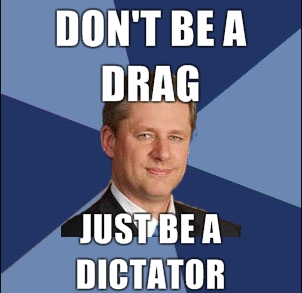
    Please keep sending me your comments and e-mails. I am an open-minded person and always ready to be convinced I should be considering a different point of view. *(None of these pictures are my own, I found them all courtesy of “Google Images”)

  • What does the Fall of “Darth Harper” and the Galactic-Canadian Empire Mean for First Nations?

    Finally, the Conservative government has been toppled by their own lies, deceit, and cover-ups. But what took so long? Did it really have to get this bad and go on for this long for the opposition parties to feel secure enough to topple the government? Where have all their values gone that they would let their citizens suffer for this long? At the top of the Conservative target list were First Nations – was no political party ready to topple the Conservative government on our behalf? If not, then what does the fall of “Darth Harper” and his twisted Galactic-Canadian Empire mean for us as First Nations? http://www.fewings.ca/web/polcan/050530DarthHarper.html For those of you who don’t already read the blogs from “Galloping Beaver”, I would highly recommend that you start. They are often insightful, critical, and sometimes even humorous. Their most recent blog was a video of Stephen Harper being compared to the evil Sith Lord, otherwise known as Senator Palpatine from Star Wars. http://thegallopingbeaver.blogspot.com/2011/03/darth-harper.html While the video is humorous, it is also scary, given that Stephen Harper ruled very much like a dictator while praising the virtues of freedom and liberty. Here is another one along the same lines: http://www.youtube.com/watch?v=CMtLkTQTn80 He will no doubt be known as one of the most dictatorial leaders in Canadian history. I have also been critical of Harper’s contempt for democracy and have spoken against his autocratic-type rule: https://pampalmater.com/2011/03/country-of-harper-are-we-moving-towards.html Now, the whole world knows that Harper’s style of rule led to the defeat of his own “empire”. The Commons Procedure and House Affairs Committee found Harper’s Conservative government to be in contempt of Parliament for refusing to disclose the real costs of “big ticket” items like the stealth combat jets, the corporate tax cuts and the infamous law and order plans to build and staff more jails. http://www.thestar.com/news/canada/politics/article/957379–committee-finds-harper-government-in-contempt The report which was released on Monday, March 21, 2011 held that: “the government’s failure to produce documents constitute a contempt of Parliament” and that “this failure impedes the House in the performance of its functions.” The Conservatives demonstrated a serious lack of honesty that could have seriously hurt many Canadians. http://www.theglobeandmail.com/news/politics/committee-finds-tories-in-contempt-for-stonewalling-on-crime-bill-costs/article1949891/ Based on this report, a vote of non-confidence was held and Harper lost. The vote was brought by the Liberals and supported by both the NDP and the Bloc. The next step in the process was for Harper to speak to the Governor General and ask him to dissolve Parliament, which he did. This means that Canadians will have an election on May 2, 2011. http://futurepocket.com/2011/03/26/canadian-government-loses-no-confidence-vote-parliament-dissolved/ This should be no surprise to anyone who owns a television, as we have now seen all the attack ads start. I am quite sure that for the next 6 weeks, we will all be exposed to very little campaigning and a whole lot of attacking. I can also predict that there will be no ads which speak to the third world conditions of First Nations in this country, or the lack of action on our land claims and treaties. I also doubt they will run their elections on removing the 2% funding cap in First Nations or designing legislation to officially recognize our sovereignty. http://www.youtube.com/watch?v=5CAyoHa17HE What does all of this mean for First Nations in this country? That is a good question. A leading Indigenous academic scholar, Taiaiake Alfred, argues that there is nothing to be gained by First Nations voting in federal elections. In his view, voting in their elections is akin to accepting their assumed sovereignty over our Nations. http://taiaiake.posterous.com/47421296 There are other Indigenous scholars, like John Borrows in “Landed Citizenship: Narratives of Aboriginal Political Participation”, who argue that we should not only put significant efforts into rebuilding our Nations, but that we should also participate in federal and provincial government processes as a means of extending our influence. While I can see the merit in both arguments, I can’t help feel that at this point in time, with the current power structures and laws we now have in Canada, that our influence in Canadian politics is negligible at best and harmful at worst. None of the federal parties have our best interests at heart. At the end of the day, our interests are just another commodity that can be bartered away for a bigger piece of another pie. Bill C-3 Gender Equity in Indian Registration Act was a prime example of the vulnerable nature of our rights. Indian women and their descendants are still – to this day – treated blatantly unequally as compared to Indian men and their descendants in Canadian law. Yet, despite Sharon McIvor winning in both levels of court, our right to equality was bartered away by national Aboriginal organizations and federal political parties for an undefined “joint process” with no clear mandate, structure, authority or funding. This left Sharon McIvor staring in disbelief before the Senate when near unanimous opposition to the bill in the House, became a trade item for a joint process in the Senate. Perhaps I am just feeling defeated? Maybe, but when I look at the process for Bill S-4 Matrimonial Real Property, Bill S-11 First Nations Safe Drinking Water, Bill C-575 First Nations Accountability and so on, a theme emerges – non-First Nations peoples and governments are designing laws and policies for our Nations based on their own priorities, not ours. In fact, there was not even any legal consultation and accommodation of our “interests” in those bills. Were it not for the dissolution of Parliament, we may well have been stuck with many new laws that would detrimentally impact our communities and Nations. Could voting in federal or provincial elections change any of this? No. We simply do not have the numbers to make a change. Sure, in some ridings, if all Aboriginal people voted, we could add a few more MPs, but these additional folks would not change the make-up of the party itself. My father once told me that politics is about making deals and trade-offs. MPs are often required to vote with the will of their party, not based on what is just. If something like our basic equality rights are up for auction, then I don’t want to be any part of that. However, I do support those rare few who participate in the Canadian process who also stay true to their Indigenous values and teachings and don’t allow others to bully them into siding with the majority vote on issues. These individuals are not the mouth-pieces of government trashing their own people, nor are they the Aboriginal faces needed to promote a new government policy that will hurt First Nations. These individuals are the rare few who stand out on committees and in the media highlighting the need to respect inherent First Nation jurisdiction. That being said, I think we have a far better shot at making real change by healing our communities with our cultures and languages, rebuilding our Nations, securing our lands and resources, and asserting our sovereignty instead of asking others to recognize it. We have to start from a position of power which means our focus should be on our Nations first – and we have a lot of work to do there. I think that our inherent sovereignty is our real power and that we need to step up our game in that department. No one is going to “give” us our sovereignty – that is something we have to believe in and do ourselves. We have to protect our jurisdiction over our people, lands, governments, and laws – or it will continue to be eroded under the guise of “reconciliation”. We also have to make sure that this next government knows we mean business – our sovereignty is not for sale, politically or otherwise. Our sovereignty is the very core of who we are as Indigenous peoples and our ancestors were willing to die to protect it. I think we have an obligation to honour their sacrifices… http://www.youtube.com/watch?v=3Ul4KmHlzMc

  • Beyond Blood: Rethinking Indigenous Identity and Belonging

    Beyond Blood: Rethinking Indigenous Identity and Belonging

    OK, so here is my shameless self-promotion – please buy my book and help me become a National Best Seller!! I would love to hear all your feedback on the ideas and issues covered in the book as well as ideas for my next book!!! You can buy my book directly from the publisher at http://www.purichpublishing.com/ or you can buy it from places like Chapters: http://www.chapters.indigo.ca/books/Beyond-Blood-Rethinking-Indigenous-Identity-Pamela-D-Palmater/9781895830606-item.html?ikwid=beyond+blood&ikwsec=Home

    Beyond Blood: Rethinking Indigenous Identity

    Dr. Pamela D. Palmater

    • What impact does status have on band membership codes?

    • What limits, if any, should be placed on the right to  determine citizenship?

    • Legal, political, and cultural factors affecting Indigenous identity and belonging

    • Interim proposed solutions to discrimination against Non-Status Indians

    “For hundreds of years, we have struggled to survive amid a patrilineal system of government. We will not continue to allow government policy to manage our affairs, decide who is Aboriginal or not based on blood quantum …” – Chief Candice Paul, St. Mary’s First Nation

    Author Pamela Palmater argues that the Indian Act’s registration provisions (status) will lead to the extinguishment of First Nations as legal and constitutional entities. The current status criteria contain descent-based rules akin to blood quantum that are particularly discriminatory against women and their descendants.

    Beginning with an historic overview of legislative enactments defining Indian status and their impact on First Nations, the author examines contemporary court rulings dealing with Aboriginal rights and the Canadian Charter of Rights and Freedoms in relation to Indigenous identity. She also examines various band membership codes to determine how they affect Indigenous identity, and how their reliance on status criteria perpetuates discrimination. She offers suggestions for a better way of determining Indigenous identity and citizenship and argues that First Nations themselves must determine their citizenship based on ties to the community, not blood or status.

    Dr. Palmater teaches politics at Ryerson University and holds a JSD in law from Dalhousie University. She was denied Indian status as a Mi’kmaq because her grandmother married a non-Indian.

    “It is time that the Indian Act was revised, section by section, in full consultation with First Nations so that we can keep the sections which benefit our communities and finally eliminate those sections which threaten our very existence. Dr. Palmater’s book raises these very important issues …” – Chief Lawrence Paul, Millbrook First Nation

    “This work is an important discourse that looks at a judicial anomaly which continues to perplex the integrity of the Canadian legal system, and illustrates the glaring contradictions of an ever-weakening Honour of the Crown.” – Chief Isadore Day, Serpent River First Nation

    $35.00, 280 pages, index, paper, 6 x 9, spring 2011                                ISBN 978-1895830-606

    Purich Publishing Ltd.                                                              P: 306-373-5311

    PO Box 23032 RPO Market Mall                                             F: 306-373-5315

    Saskatoon SK S7J 5H3                                                   E: purich@sasktel.net


    Visit www.purichpublishing.com or ask at your local book retailer

  • “No Natives” Allowed: How Canada Breeds Racism and Fear

    On the one hand, I cannot believe that we as Indigenous peoples are still subjected to such overt racism on a such a frequent basis. On the other hand, I am not surprised, given that this kind of anti-First Nation sentiment is still out there in more hidden forms also known as systemic racism. I guess the best way to describe my feelings is that I sometimes feel overwhelmed that these perverse ideologies don’t just come from a few wackos, but comes from all elements in society – individuals, business, professionals, academics, politicians, and government.

    I received this picture from people on Facebook today who wanted to bring this issue to the attention of the public and the police. This picture is allegedly of a restaurant in Lakefield, Ontario. It was reported in the Toronto Sun that the police are investigating this as a hate crime. Here is the link to that story: http://www.torontosun.com/news/canada/2011/03/16/17638211.html If this incident actually happened (and everyone is innocent until proven guilty), it is a symptom of how Indigenous peoples are portrayed generally in our society – in schools, the media and by federal and provincial governments. Even if this one turns out to all a big misunderstanding, there used to be many similar signs like this, just for Aboriginal people:

    I am less surprised by this kind of overt racism from members of small communities, when I hear famous people, like Kevin O’Leary (who appears on Dragon’s Den and CBC News’ Lang & O”Leary show). You will recall, that Kevin O’Leary called his co-host an “Indian giver” and when she rebuked him for such barbaric language, he repeated the phrase and defended his use of it. http://www.thestar.com/news/canada/article/950584–cbc-ombud-slams-o-leary-s-offensive-on-air-comment This comment was made on Canada’s CBC News during prime time when a large number of Canadians would be watching. It happened LAST October 2010 and not a word of apology was issued by O’Leary or CBC. It wasn’t until 5 months later and AFTER the CBC Ombudsperson had publicly released their decision that the comment was wrong and so was CBC for not immediately addressing it – that we heard any mention of an apology. Specifically, the Ombudsperson stated: “In this instance, the preferred course would have been for O’Leary not only to privately recognize the fault of his ways but to publicly express remorse, either that night or the next night or soon after. But if he wasn’t going to publicly apologize, the program could have done something further to make amends. Its obligation goes beyond the complainant to the viewers in order to uphold the broader reputation of the program and CBC itself.” http://www.cbc.ca/ombudsman/pdf/2011-03-02-Jamieson.pdf This is obviously the point I am getting at about the effect such comments have, especially when left for many months to fester. The problem is that Indigenous peoples are getting it from all sides and by not acting to address these issues, it’s no wonder society thinks this is acceptable. Scripted apologies forced by legal decisions, litigation or threat of job loss are hardly sincere or even effective at undoing the damage caused. http://www.nationalpost.com/news/canada/pundit+censured+offensive+exchange/4399119/story.html You will recall on the very same day that Prime Minister Stephen Harper offered a public apology on behalf of all Canadians for the physical, sexual, and other abuses committed in residential schools, his conservative MP, Pierre Poilievre, had the nerve to question the compensation being given to survivors and asked whether it was “value for money”. I still feel nauseated when I read his comments. As if there is any monetary amount that could ever compensate for sexual abuse like rape, physical abuse like beatings, neglect that resulted in many deaths and the loss of culture, language and hope. http://www2.macleans.ca/2008/06/11/pierre-poilievre-shows-his-empathy-for-residential-school-survivors/ Keep in mind, Canada has compensated Japanese families for ripping them from their homes and putting them in camps during the war. The Chinese were also compensated for the head tax that was imposed on them to prevent them from immigrating to Canada. While the Supreme Court of Canada has specifically said that discrimination is not “a race to the bottom” (i.e. who is more discriminated against), they have said that often times Aboriginal peoples are dually disadvantaged on mulitple levels not necessarily experienced by other groups. http://www.canlii.org/en/ca/scc/doc/1999/1999canlii687/1999canlii687.pdf Indigenous peoples suffered in residential schools for their entire childhoods and many others suffer the deadly inter-generational effects for communities all over the country which could take generations to address. How could the residential school compensation be less “value for money” than another group’s? Somehow, conservatives and others find a way to insert doubt and blame into the conversation when it is about Indigenous peoples. We all know about Senator Patrick Brazeau who uses the Senate chambers, resources, and logo to film carefully worded videos meant to portray First Nations as lazy and corrupt. In fact, on my previous blogs, I have highlighted his negative, stereotypes of First Nations and how in one show he even accused First Nations as hubs of “illegal activity”. This all coming from an individual who claims to be First Nations – imagine the powerful effect this would have on the views and opinions of non-Aboriginal peoples. That brings us to Minister of Indian Affairs, John Duncan. As you know from my previous blogs, I am no fan of Minister Duncan given his past racist comments about Indigenous peoples and their rights. https://pampalmater.com/2010/09/indian-agents-are-back-pm-new-indian.html Duncan was very much opposed to Aboriginal and treaty rights to fish, ignored their constitutional protection, and characterized them as “race-based”. http://www.mediaindigena.com/rickharp/issues-and-politics/indian-affairs-minister-john-duncan-menacing-or-muzzled More recently, however, Minister Duncan appeared before the Senate Committee on Aboriginal Peoples regarding Bill S-11, the bill dealing with safe drinking water on First Nations. Senators have commented that all witnesses, both Aboriginal and non-Aboriginal alike, including water experts and legal experts all agree that this Act is so bad that even amendments could not save it. On March 8, 2011, Minister Duncan, expressing his frustration, commented that:

    “This committee has been receiving a very one-sided view on the way things are going.  We’ve actually been working very collaboratively especially with the Treaty 6, 7 and 8 group from Alberta….  You’re correct in concluding that everyone does not have the same view.  But I think this committee has managed to somehow capture a prevalence of negative views.  Sometimes that’s what happens.  It’s easier  in First Nation politics to be aggressively  contrary to something than it is to be supportive.  And that’s an observation that I will make and stand behind and it’s something I hope we can change

    How could we as Indigenous peoples NOT be, at the very least, “agressively contrary” to the sexual abuse in residential schools, the outlawing of our cultures, the legislated exclusion of our women and children from our Nations, the removal of thousands of our children to child welfare agencies, the early deaths of our people from extreme poverty, the theft of our traditional lands and resources,  and the political and legal destruction of our laws, governments and communities? In other countries, this can and has resulted in revolutions. While I can’t say for sure what was going on in his head, it certainly appears to me that Minister Duncan gave his comment some thought before he said it as he followed up his comment with confirmation that he will stand behind it. This is not dissimilar to Kevin O”Leary standing beside his racist remarks, or Tom Flanagan standing beside his comments. I have always been told to believe people when they tell you who they really are – so I am listening. Aside from showing a pre-disposition to having racist views about Indigenous peoples, Minister Duncan’s negative stereotyping of First Nations does little to suggest his views have evolved over time. Looking at it from society’s point of view, if the Minister of Indian Affairs, who is supposed to be an advocate and champion for Aboriginal peoples in Canada has such hostile, negative views about Aboriginal peoples, why would we expect society to be any better? It is almost as if Minister Duncan is sickened to even have to work on this portfolio – which begs the question – why the heck does he?

    Sadly, comments by our top law enforcement agencies about Indigenous peoples do not fair any better. Official documents in the Canadian Military have characterized Mohawks as insurgents or terrorists. This not only false and offensive, it also serves to spread fear and distrust amongst non-Indigenous society. My children’s own friends ask questions about whether we are “terrorists”.

    http://video.ca.msn.com/watch/video/military-apologizing-to-mohawks/16ahlo0dq

    The damage has been done. No carefully worded apology will be able to undo the damage to Indigenous peoples and especially the Mohawk in this case. Canadians are more likely to see us as terrorists than the First Peoples of this country. If there was any doubt, just ask Christy Blatchford and TVO, who portrayed Mohawks in Six Nations as lawless and out of control: https://pampalmater.com/2011/01/update-tvo-agenda-botches-show-on.html

    Yet, despite the military’s indication in 2010 that they would be offering a very carefully worded apology, one remains to be given. Many months later and not a single word has been issued. It makes me wonder what kind of priority they made of the apology. Instead, there seems to be a universal default that these comments will be allowed to be said, defended, repeated, and given time to sink in before any superficial apology is offered. We deserve more than this anti-First Nation propaganda on our own homelands.  http://www.montrealgazette.com/news/Military+apologize+Mohawk+Warriors/4015748/story.html

    Add to this the list of right-wing academics who promote the assimilation of Aboriginal peoples in various forms like Tom Flanagan, Dale Gibson, Frances Widdowson, and Alan Cairns, etc. This is reinforced by some teachers in schools which either don’t teach their students about Aboriginal peoples, do so in a minimal way or teach some of these same stereotypes. This is further reinforced by the various media outlets who make millions off portraying First Nations as lazy, crooked, criminals and movies or TV shows which promote an archetype of Indians that few today can live up to – the “good” version or the “bad” version.

    This is an old battle, one that we have been fighting since contact. While many in society would like to believe that old colonial ideologies about Indigenous peoples have long waned, the opposite is true. Just take a peek at some of the vile comments posted on online media stories about Indigenous peoples and you’ll see what I mean. Not only do Indigenous peoples face this battle on multiple fronts and on a daily basis, but they must also face the battle within themselves, Every day we face the battle to prove we are worthy as human beings. Too often this battle is lost and we lose our young people to suicide, violent deaths, and early deaths from diseases, malnutrition, and lack of housing caused by extreme poverty.

    I’d like to point out that the Criminal Code of Canada specifically prohibits hate crimes (section 319) which provides that public statements made against an identifiable group that incites violence against that group is a CRIME. Similarly, section 318 specifically probihits GENOCIDE – which is the killing of an identifiable group, or creating lufe conditions would bring about that group’s physical destruction. Sounds like an option, but the tricky part is you have to get the Attorney General to agree to bring these charges. So, back to the drawing board…while assimilation, racism, theft of our lands, resources and souls continues…

    Those of us who manage to wake up every day and win this internal battle (at least enough to keep trudging along), must then engage in the political and legal battle for our basic human rights and freedoms, to protect our cultures and identities for future generations, as well as the key issues like sovereignty, Aboriginal and treaty rights, land rights and so on. We have to know more than anyone else about our issues, we have to work harder than anyone else, and we have to find ways to do so politely and with smiles on our faces lest we be characterized as “agressively contrary” or “terrorists”. So the next time you hear someone say how easy First Nations have it; how they get everything for free; or how lazy they all are, why don’t you suggest they live with Indigenous peoples for a while and see what the “free & easy” life is really like? Or perhaps they’d like to discuss the subject with those of us who fight in this battle 24-7? It is time Canada accepted the fact that we will not be assimilated. Whether you call it “agressively contrary”, “insurgency” or “criminal” – we will continue to protect our cultures and identites for future generations. If only Canadians could leave their minds open long enough to see the incredible strength of our diverse peoples, the beauty of our rich cultures and traditions, the unique ties we have to our territories, or the incredible pride we have in our identities – then they would see why we refuse to give it up.

  • The Country of Harper: Are We Moving Towards an Autocracy?

    I am absolutely stunned by what has been happening in politics lately. Canada used to pride itself in being a democracy, but in recent years under the Conservative government, we have moved further and further away from a real democracy that represents the voice of the people, and have moved closer and closer to an autocracy. An autocracy is a form of government where one person possesses unlimited power. Leaders who are autocrats are sometimes referred to as dictators or tyrants. Some of you who are political scientists or armchair critics might be thinking that Canada is not really an autocracy because we have a Constitution (which is the supreme law of the land), an independent judiciary and free elections. That is absolutely true. Technically, Canada is set up as a democracy – rule by the people. However, what is happening in practice differs a great deal from how things are SUPPOSED to work. Some key events have made me question where we are headed. My fear is that we may be repeating history under the guise of politics. Don’t forget, some of the worst of tyrants and dictators started out as something else – passionate leaders for a cause which they believed to be “good”. Just to be absolutely clear – I am not a member of any political party – Liberal, Conservative, or NDP. Nor am I a member of any other federal party of which, you might be surprised to know, there are quite a few: http://www.altstuff.com/federal.htm So this isn’t an election smear campaign, promo ad for the liberals, or pro-NDP blog. This blog represents my thoughts on what is happening based on all my knowledge, experience, education and most of all, my common sense. It is my personal opinion, and I am entitled by law to exercise my freedom of expression and share my personal views with the world. This freedom, as with other rights, are guaranteed in the Canadian Charter of Rights and Freedoms: http://www.canlii.org/en/ca/const/const1982.html  2. Everyone has the following fundamental freedoms: (a) freedom of conscience and religion; (b) freedom of thought, belief, opinion and expression, including freedom of the press and other media of communication; (c) freedom of peaceful assembly; and (d) freedom of association. As integral as these ideals are to our democratic society, under the Harper regime (or whatever it is), these rights are slowly but surely being eroded. I have to worry now, whether my personal views and opinions are safe from unreasonable and arbitrary interference, when I hear reports that the government has contracted private companies to monitor our Facebook postings and other social media sites: http://www.ctv.ca/CTVNews/QPeriod/20100523/government-online-forums-100523/ Seriously? I knew there were some looney-toons sending me messages, but this is too much. Who is Canada to invade our social spaces, where we enjoy the freedom to discuss what we want, and add what THEY view to be the CORRECT information in our discussions? What about politics is correct – or is there only one way of thinking now? This sounds eerily close to other countries which do not allow dissent or who control social media communication. Is this where Canada is headed? You may have also heard the latest about Prime Minister Harper changing the name of our Canadian Government to the “Harper Government”. I thought it was a joke at first, but no, this is serious: http://ca.news.yahoo.com/grit-ads-blast-harper-government-rebrand-20110304-142800-929.html How could a democracy, which is truly governed by the people, have the name of the people’s government changed to reflect a single leader’s name without consulting with the people? Canada is not the sum total of Stephen Harper (thank goodness), so how on earth could he be so egotistical to think Canadians would agree to this? http://ca.news.yahoo.com/tories-rebrand-govt-canada-harper-govt-expert-says-20110303-125237-072.html Our government is supposed to represent all of its people – not a single leader. Nothing good can come from boiling down our government to one person – we have seen what happens when individual leaders think they are all powerful. I can understand the layman’s use of that kind of terminology, as the media does it all the time. However, they do so as a short-cut to saying what the Conservatives, in general, are doing as opposed to saying Canada is Harper. In the United States of America, the media often refers to the Obama administration, but you NEVER hear the government refer to itself as the United States of Obama. http://www.theglobeandmail.com/news/politics/harper-accused-of-shaping-language-for-political-ends/article1929548/ What makes this all the more suspicious is that they did this all in great secrecy. We might not even know this change has happened but for a bureaucrat “inadvertently” bringing the news to light. This is very characteristic of how the “Harper” government works. When the “Harper” government tried to defend itself by saying that Chretien used to do the same thing, lifelong politicians quickly pointed out that this was not the case. “Mr. Chretien . . . had way too much respect for our public institutions to cheapen them the way Harper has and he didn’t have the political megalomania the way Harper has to ensure his likeness or name was stamped on everything the government does.” In fact, many long-time politicians have pointed out that this name change even violates the Federal Identity Program Policy: http://www.tbs-sct.gc.ca/pol/doc-eng.aspx?id=12314&section=text One of the objectives of this policy is to help “project the Government of Canada as a coherent, unified administration“. This can’t be the case if a name is chosen which reflects only one person and is obviously partisan in nature. The policy goes on to state that “the “Canada” wordmark are applied wherever an activity of the federal government is to be made known in Canada and abroad“. This includes communications with other states. Similarly, the Communication Policy of the Government of Canada is designed to “Ensure that institutions of the Government of Canada are visible, accessible and accountable to the public they serve” and that key messages represent our diversity. There is nothing diverse about changing our government’s name to “Harper Government”. All this does is send the message that Canada is a one-man show: http://www.tbs-sct.gc.ca/pubs_pol/sipubs/comm/cph-fspc01-eng.asp#_Toc141192549 To put it simply, Canada is not now, nor has it ever been represented by one single autocrat, tyrant, or dictator, nor should it be in the future. Who is Harper to be so egotistical and ethnocentric to think that a white man could stand before the world and say that HE is Canada. How quickly he has forgotten the First Peoples of this Country and that our identity and rights are protected in the Supreme Law of Canada – the Constitution Act, 1982. I don’t see Harper’s name ANYWHERE in the Constitution. Perhaps we should change the name to the Aboriginal Peoples Government – maybe that would end Canada’s paternalistic hold over our communities and “re-brand” Canada in a more realistic way. After all, this is our territory. I think that every person who reads this blog should file an official complaint with the Treasury Board of Canada who is responsible for overseeing these rules and policies. http://www.tbs-sct.gc.ca/tbs-sct/cmn/contact-eng.asp Then, take another 5 minutes and e-mail all MPs at the following addresses: To contact Liberal MPs – LIBMEM@parl.gc.ca To contact Bloc MPs – BQMEM@parl.gc.ca To contact Conservative MPs – CPCMEM@parl.gc.ca To contact NDP MPs – NDPMEM@parl.gc.ca I welcome any comments and feedback at palmater@indigenousnationhood.com

  • Mohawk Tobacco Trade – Standing up for Our Sovereignty

    The days of only looking at issues that impact our local communities (bands) are long over if we expect to protect our cultures, identities and Nations for future generations. The issue of our sovereignty as Indigenous Nations (Mohawk, Mi’kmaq, Maliseet, etc) must be looked at in the bigger context. I am the first to admit that we have significant issues to address in our home communities and many of them are absolutely life and death issues related to poverty, addictions, housing, violence, and child welfare. It is critical that we ensure we have citizens dedicated to addressing these issues for the well-being of our families, communities and Nations. At the same time, we also have to dedicate some of our citizens to fighting the larger battle which is being waged against our identities, cultures, and sovereignty. In the days of my great grandfather and his grandfathers, Mi’kmaq people made sure they protected their women and children by having warriors posted at our our local settlements. However, knowing that our territory (known as Mi’kma’ki) was rich in resources and our traditional territory was vast (7 districts covering many provinces), we also ensured that all directions were protected from intrusion by other Nations. The idea being that you had to have all directions covered, even if one direction required more attention at any particular time. The same can be said about our current state of affairs. Our social issues have taken such priority, that in some ways we may have left ourselves vulnerable to attack from other directions. I don’t just mean within our own Nations either. If the sovereignty of the Mohawk is being challenged, that has a direct impact on the future of Mi’kmaq sovereignty and vice-versa. Similarly, every Indigenous Nation in this country has its own special resources that is uses to support its communities and whether it is tobacco, lobster, moose, seal or oil, we owe it to each other to not allow government or corporations to jeopardize what little we have left. We can’t think for a minute that the loss of lobster fishing for the Mi’kmaq will not have a significant impact for the Maliseet and their logging rights. We owe it to our Nations and our future generations to make sure that our political strategies have all the bases covered. It is for this reason that I write about the Mohawk Tobacco trade. The Aboriginal right of the Mohawk to engage in their centuries-old trading activities is being threatened by big business and provincial governments all of whom are desperate to get their hands on money which rightfully belongs to the Mohawk. Similarly, the self-determining rights of the Mohawk to exercise jurisdiction over their own political and business activities threatens their very sovereignty. http://aptn.ca/pages/news/2011/01/15/smokes-seized-on-alberta-first-nation-had-federal-stamp-commission/ http://aptn.ca/pages/news/2011/02/02/tobacco-battle-flares-in-two-more-provinces/ As many of you know, many of the traditional Mohawk territories in what is now Ontario, Quebec and the USA have lands which are particularly suited to the growing of tobacco, which is why they have engaged in growing tobacco for many years. Their traditional use and trade of tobacco has evolved into a larger scale tobacco growing, manufacturing, sales and trade industry. Today, First Nations like Six Nations and Kahnawake are engaged in various elements of the tobacco trade. One of those companies, Rainbow Tobacco, is based on Mohawk territory in Kahnawake. They have had their shipments of tobacco to other First Nations seized by several provinces for failure to have provincial markings on their cigarettes, despite the fact that they did have federal markings. This only appears to be an issue since  non-Indigenous businesses started complaining. However, these groups try to sway public opinion by categorizing the Mohawk Tobacco Trade as “illegal” and “contraband”. By using this kind of language, it relegates Indigenous peoples to criminal status and detracts from any arguments they might make in their own defense. http://aptn.ca/pages/news/2011/02/25/charges-against-rainbow-tobacco-band-politicians-looming-rcmp/ The following arguments have been made against the Mohawk tobacco trade: (1) It is illegal because there are no provincial stamps. In fact, there is no requirement that First Nation products have provincial approvals. The cigarettes had the proper federal stamps, and since jurisdiction (as between feds-provs) with regards to First Nations, their lands and property, vests in the FEDERAL government, the province would be ultra vires (outside the scope of their legislative authority) should they attempt to legislate in this regard. In case anyone needs a reminder, here is what the Indian Act, 1985 has to say about the matter: Section 87 – the interests of Indians and bands in reserve lands AND the personal property of Indians and band on a reserve are NOT subject to taxation; Section 89 – the real (land) or personal (movable) property of Indians and bands on a reserve (or deemed to be on a reserve) are NOT subject to: charge, pledge, mortgage, attachment, levy, SEIZURE, distress or executive in favour of ANY PERSON, other than an Indian or band; Section 91 – certain property can’t be traded by Indians like: grave poles, totem poles, rocks with paintings, but tobacco is NOT one of them; Section 93 – can’t remove certain materials from reserves like minerals, stone, timber etc without a permit, but tobacco is NOT one of them. The Mohawk tobacco is not illegal, not subject to provincial tax or jurisdiction and the province had no right to seize anything on any reserve. (2) Smoking is bad for you and causes too many health problems. There is no doubt that smoking is bad for you and does cause way too many health problems that can even result in one’s death. I don’t smoke and I don’t ever want my children to smoke either. My father smoked and he died of lung cancer. I would never want that for any family or community. However, the issue of whether or not to engage in smoking is not the matter in question. The issue is whether or not First Nations can grow, manufacture, sell and trade tobacco products on their traditional territories and/or between First Nation reserves. First Nations have no less of a right to make a living off the resources on their territories than all the settlers who made good use of our lands. In fact, First Nations have a constitutionally protected right to do so – this is something that non-Indigenous businesses can’t say. The double-standard inherent in this ideology is obvious. It is legal and publically acceptable for non-Indigenous businesses to manufacture and trade tobacco, but it is a moral sin when First Nations do it. This has nothing to do with morals and everything to do with the bottom-line: the provinces see it as a cash grab and corporations see it as losing “their” profits. (3) Tobacco can only be used by First Nations as it was used traditionally. This line of reasoning is not only racist, it is legally inaccurate. The Supreme Court of Canada has clarified on many occasions that Aboriginal peoples and their rights are NOT to be frozen in pre-contact times. The SCC has further clarified that Aboriginal rights are able to evolve over time into modern methods of exercising those rights. Telling First Nations they can only use tobacco as they did in pre-contact times would be like us telling lawyers they still have to wear white wigs in court or that you have to take the Mayflower boat on your next holiday to Cuba. (4) Most of the First Nation tobacco companies are owned by band members and not the band. Regardless of my own personal feelings about individual vs. band owned businesses, again this is not the issue at hand. Those are debates to be had between band members and their bands or citizens within Indigenous Nations. I am stunned however, by the hypocrisy of statements like this when they come from the same right-wing people who are advocating the privatization of reserve lands. You simply can’t have it both ways. (5) Indigenous peoples should compete in the market place on the same level as everyone else. People who advocate this line of reasoning are usually the non-Indigenous tobacco companies or retailers who blame their poor sales on Indigenous tobacco trade as opposed to the decline in tobacco usage in Canada. What they forget is that the “market place” is fueled by the lands and resources, and the spin off taxes and businesses, which rightfully belong to First Nations. How is it that settlers could steal our lands and resources, use them to make a profit, and then when First Nations get into the market place with what little resources they have left, all hell breaks loose? They also forget that the provisions of the Indian Act noted above are legal rights afforded to First Nations. Their Aboriginal and treaty rights are also constitutionally protected. The issue is not whether the settler society likes that Aboriginal and treaty rights are protected, the fact of the matter is that they are the supreme law of the land. (6) Indigenous peoples use the money from the tobacco trade to fund all sorts of illegal activities like drugs. This ludicrous, stereotype is advanced by people like conservative Senator Patrick Brazeau. If you view the following video, you’ll hear him make this racist stereotype against First Nations: http://aptn.ca/pages/news/2011/02/04/aptns-mp-panel-back-in-business-but-for-how-long/ There are always individuals who break the law in Canada. That does not mean Canadians are all crooks. Robert Pickton was a serial killer, does that mean all Caucasian people in Canada are serial killers? Of course not. Then why is it acceptable for Senators and others to advance such disgusting racist stereotypes against our people? We have to call them on it, and then get back to the real issue: we are sovereign nations and our sovereignty has been challenged here. While you may not personally like tobacco, that is not the issue. Mohawks engaged in their traditional tobacco trade are no more criminals than Mi’kmaq people fishing lobster. Yet, when the Mi’kmaq proved their treaty right to fish and sell lobster, the non-Indigenous fishers could not accept having to share what was never theirs to begin with. It resulted in government officials riding their boats over our people (literally) and calling us criminals and in the media said we were engaged in illegal fishing. http://www.youtube.com/watch?v=HsvG4KpFHOA If we do not stand up for our sovereignty at EVERY instance that it is challenged, including those times when we don’t like the issue, then we’ll have no defense when we want to exercise it for issues we do like, i.e., land and hunting. We  owe it to each other to get each other’s backs and to ensure that all our directions are covered. There is no negotiation when it comes to sovereignty. Our heroes were not well-paid lawyers or consultants – they had nothing and risked their lives for us. We have to prove to our future generations that we were worth the fight. http://www.youtube.com/watch?v=3Ul4KmHlzMc

  • Rise of the Eastern Empire: Lavallee’s Plan to Dismantle the Congress of Aboriginal Peoples

    This blog is about CAP’s demise and to ask whether anyone cares? I would love to hear from folks about this blog and CAP in general. I worried about using “Congress of Aboriginal Peoples” as the title to this blog because I assumed that most of you would be thinking “Who?”. Seriously though, some of you may be wondering what the heck has happened to the Congress of Aboriginal Peoples (CAP). In my last blog, I wrote that they have essentially fallen off the face of the earth. https://pampalmater.com/2010/11/slow-painful-death-of-cap-can-it-be.html We (those who live off-reserve in Canada) do not ever hear from CAP or its President Betty-Ann Lavallee in the media, in the community, or anywhere else for that matter. On APTN’s InFocus (Jan.21, 2011 edition), the political panel talked about how irrelevant organizations like CAP are when they do not reach out to the people they claim to represent. http://aptn.ca/pages/news/2011/01/24/january-21-2011/ Aside from CAP’s lack of engagement with the substantial Aboriginal population that lives off-reserve in Canada (50% of total Aboriginal population), CAP’s current President is taking the organization on a nosedive into oblivion and if those who care about the organization don’t do something soon, it could be gone forever. Many of you who have contacted me have indicated that it is your opinion that President Lavallee simply doesn’t have the skills or capacity to lead a national organization because as many have commented, she nearly tanked her own provincial organization in New Brunswick – the New Brunswick Aboriginal Peoples Council (NBAPC) and at the very least, made it politically irrelevant. http://www.nbapc.org/ I appreciate the feedback from grassroots folks and I can definitely relate. In fact, I used to be a member of the NBAPC and watched the organization grow over the last 40 years and have actually seen it when it was a strong political voice and engaged with the off-reserve community. Sadly, I have also seen it in the last 10-15 years slowly become less effective as a political voice, less engaged with the off-reserve Aboriginal people and become an elite club that would rather spend money on lawyers against their own membership than use those lawyers to defend our Aboriginal and treaty rights. Why has the NBAPC gone downhill after such a strong history? Many of you have commented that the reason is Lavallee’s poor leadership skills, her lack of knowledge on Aboriginal issues, her lack of connection to our First Nation communities, her lack of political experience, and some have even suggested that she has other, more sinister motives. While I respect everyone’s opinions, I always base my opinions on fact versus conjecture, but in this case, they proved to be one in the same. I personally can speak to a time when the mood of the community was to have a non-confidence vote and remove Lavallee as President of NBAPC, so instead of dealing with the issue, she skipped the Annual General Meeting (AGM). At subsequent meetings, she claimed that she could not be removed as President because she was an employee of NBAPC and not a political leader. Her lawyer started appearing at more and more meetings, which had the effect (for many) of effectively silencing them. If that does not say it all, I don’t know what does. Our people elect leaders to speak for them, not to be lead by lawyers, consultants, or staff. The situation had become so bad, many people simply stopped participating. I for one, resigned as a member so that I could exercise my voice without fear of retaliation. AGMs became more predicatible as Lavallee did not report on significant accomplishments she made for NBAPC each year, instead we got a copy of her calendar which said which days she was in the office and which days she was out sick. As members started to speak out, ask questions and demand more, Lavallee started to attend AGMs and board meetings with her lawyer. We knew then that there was no getting rid of her unless she left voluntarily. Then when Patrick Brazeau jumped ship to become a conservative Senator, Lavallee set her sights on CAP. As I explained in my last blog, many off-reserve folks thought that the only way to get rid of her in NB was to vote her in as President of CAP, because CAP’s Constitution and By-laws had a specific provision that would allow votes of non-confidence. http://www.abo-peoples.org/CAP/About/CAP_ByLaws_Constitution_2007.pdf As expected, Lavallee was voted in as President and CAP has been dying a slow death ever since. However, while I used to think it was a capacity issue: poor leadership skills and a lack of knowledge and experience – I was shocked to find out it was her plan all along. It is no accident that CAP is dying, in fact when Lavallee was President of the NBAPC AND the Vice-President of CAP, she called for CAP to be dismantled! It gets worse than this – not only did she want CAP to be dismantled, but she wanted the financial support to be funnelled back east to support her organization and that of those affiliated with the Maritime Aboriginal Peoples Council (MAPC) an organization that represents the NBAPC, Native Council of Nova Scotia (NCNS) and the Native Council of PEI (NCPEI). http://www.ikanawtiket.ca/ How do I know this? Well, today I was sent a copy of a letter dated May 28, 2009 that was addressed to Fred Caron, ADM of the Office of the Federal Interlocutor for Metis and Non-Status Indians, and signed by Lavallee when she was President of NBAPC and Vice-President of CAP. It is not posted online anywhere, so I will reproduce the text below (all the grammar and spelling mistakes are from the letter itself): “As you know, for many years now we have discussed the idea of ways we could make the Maritime Aboriginal Peoples Council more recognized as a real credible organization. In the East, we have run it so far as a formal group but now I think it is the right time to go further and officially recognize the important role it plays for Aboriginal people here in Eastern Canada. It is the right time to do this now when you consider the problems that CAP is facing now as a National organization. We seen the failure of OMAA in 2005 and also the addition of some affiliates in the West that are very questionable. We are very concerned that the new affiliates in Ontario, Manitoba, Saskatchewan still don’t get core funding and do not have real membership. This hurts the national organization in terms of credibility as well as reputation and it is not fair for the Eastern PTO’s. We should not have to suffer because these groups cannot get their organizations running effectively. Maybe the time has come to turn away from CAP and to regroup around the east where the affiliates are running very well and have real and successful operations. We have a long and successful history compared to those in the West and we play by the rules. I am worried that if we continue to be a part of a national organization with serious and many debt and governance problems that other PTOs have created we in the East will ultimately be severely affected.” Not only was Lavallee trying to tank CAP when she was one of its provincial affiliates, but according to the Board, she was also the Vice-President of CAP at the time. I wonder if Brazeau was aware he was being stabbed in the back? That letter alone should have prevented her from running for the position as President of CAP given her obvious bias towards tanking it. It should also be at the top of the list for bringing about an immediate vote of non-confidence. However, the issue that I am most concerned about regarding Lavallee, relates to the lack of voice by the grass roots people. They say that Lavallee NEVER consulted with her membership in NB about writing such a letter or taking such a position. Other members from other affiliates say they were never consulted by her keeping in mind she was the Vice-President at the time. To call for the end of the NBAPC’s national organization should have been an agenda item at an AGM, it not a special consultation meeting in and of itself. I would also venture to guess that this should have been an agenda item at CAP’s own board meeting. What also strikes me is the hypocrisy of the letter. As former Vice-President and board member of CAP, it was her job to support the other affiliates and to direct resources towards assisting the other affiliates in obtaining core funding so that they could build capacity. Currently, as the President of CAP, the buck stops with her. If her affiliates are struggling, it is her job as a leader to make assisting those affiliates her number one priority. Instead, Board members report that she takes trips to places like Bolivia or the Olympics instead of taking care of what appears to be urgent business at CAP. If CAP is failing, Lavallee need only point the finger at one person – herself, seeing as she is the President, Chief AND CEO of CAP. I am told by members of the Board, that at CAP’s recent governance training, the person who conducted the training was surprised that Lavallee was the President, Chief and CEO of CAP. They felt that this was highly unusual and apparently the discussion centred on the fact that it felt like a dictatorship. CAP has apparently mixed both the political side of the house with the administrative side which means that CAP mixes politics and business. I am also told that all employees must report to her and that politics often factors into daily administrative decisions. This might be one of the reasons why there are pending lawsuits against CAP – but I can’t say for sure as I don’t have copies of those lawsuits. I am further told by various Board members that the level of dysfunction within CAP has increased ten-fold as Lavallee has been the centre of much in-fighting among the board. I have copies of e-mails and letters from Lavallee and the NBAPC President Kim McKinley which are appear to be particularly targeted at certain affiliates. If you read the above letter, it is no surprise that Ontario, Manitoba and Saskatchewan bear the brunt of Lavallee’s scorn. The hypocrisy continues at the financial level as well. At CAP’s last AGM it was reported to the members that CAP was in a major deficit of over $1.2 million dollars. Yet, no debt reduction strategy was presented to the AGM. Some board members of CAP estimate that CAP’s deficit may well be close to $2 million dollars at this point. Assuming for a minute that the deficit is “only” $1.2 million, then CAP has a great deal of work to do to get back on track. There is no way to tell for sure, as CAP’s website link to its “financial reports” does not contain any information: http://www.abo-peoples.org/index.php?option=com_content&view=article&id=25&Itemid=35 How has CAP done this? Well, aside from Lavallee’s trips to Bolivia and the Olympics, the board reports that she also gave herself a salary increase. While she wanted a much bigger increase, she did come away with a significant raise. Similarly, at Christmas time, the Board indicates that she gave herself a nice bonus of $1000 dollars and gave staff members all $500. At the same time, I had former staff contacting me saying they were being laid off due to budgetary issues. Something doesn’t add up in CAP’s math? I am sure members of CAP’s affiliates will be left wondering how Lavallee could possibly justify her own base salary given her lack of productivity for CAP, let alone salary increases, trips, and bonuses when CAP is in such serious financial troubles. The Native Council of Canada used to mean something. It was part of the constitutional talks and intervened on many important matters for Aboriginal peoples living off reserve. Its name change to CAP has not brought with it a strong vision for uniting its affiliates across the country, nor has it engaged with the people who need it most – the off-reserve grass roots people. Instead, Lavallee has transported her dysfunctional, anti-CAP form of leadership from NB to Ottawa, and the grass roots people are paying the price. Based on the information that I have been receiving about its internal dysfunction, I can only guess that CAP is slowly imploding – but not due to a lack of capacity. In fact, some might argue that this sad situation is not fate, but is being actively promoted by its own President – Betty-Ann Lavallee. In December 2010, CAP sent a letter to the Indigenous Peoples Confederacy (CAP’s Manitoba affiliate) and said they were no longer in good standing with CAP. It appears as though CAP may be doing the same thing to Saskatchewan and one wonders if OACP is next? Some fear that Lavallee is well on the way to seeing her stated goal to fruition – the end of CAP and the rise of her Eastern Empire. Lavallee: “the time has come to turn away from CAP and to regroup around the East” I am not sure what the answer is, but surely it must involve the grass roots shaking the rotten apples from the tree and getting their organization back to where it used to be. I’d be happy to hear any feedback about the information in this blog or whether anyone cares about CAP anymore.

  • Jordan’s Principle and Standing Up for Those Who Can’t

    Ok, I have to get back to dealing with the real issues. I can’t waste any more time on the Senator. I feel confident that our First Nations leaders on and off reserve will ensure that no one speaks on our behalf who hasn’t been chosen to do so by our people. Also, I have a huge family who always supports me but doesn’t hesitate to remind me to stay focused. They clearly don’t want me to stoop to his level and give him any more fame than he already has. There are far too many important issues that need to be addressed and I love my family for keeping me on the right path. So, back to it… Recently, I attended a conference full of amazing Indigenous women leaders in Newfoundland. Just being a part of their event was a humbling experience for me. Attending gatherings of strong Indigenous women like this always reminds me of how little I know and how much I have to learn. Although I had travelled to Newfoundland feeling under the weather and a little stressed out from my recent workload, when I arrived in that room, I could literally feel the energy of these women surrounding me. I was awed by their dedication to their community despite their personal struggles; their supportive words to one another, despite their own lack of support from others; and their warmth and welcoming to me as a non-Islander, despite their personal histories of trauma and loss. They reminded me that despite our differences, we have to keep our eye on the ball, so to speak, and focus on our communities. There are a good number of people who need our help right now and they don’t have the same capacity as we do to advocate on their own behalf. So, when one of the ladies asked me what Jordan’s principle was, I agreed to blog about it so that we’d all know what it was and how we can all put pressure on federal and provincial governments to finally implement it. Jordan River Anderson was a small boy who was a member of the Norway House Cree Nation in Manitoba. He was born with some serious health issues and required extensive hospital care. When he was two years old, his doctors determined that he was well enough to go home so long as his house was properly outfitted for his needs and he had care specific to his needs. It was at this point that the federal and provincial government re-engaged in their decades old debate over who should pay for the health costs associated with caring for little Jordan. Canada argued that health care was provincial jurisdiction and the province argued that status Indians living on reserve were federal jurisdiction. Because neither government would agree to pay for Jordan’s health care costs to live at home with his family, this little boy was forced to stay in the hospital for the next two and half years until he passed away. His family never got to take him home. For anyone who does not understand what exactly the jurisdictional issue is, here is a mini-overview. Our Constitution Act, 1867 sets out the specific areas of power that the federal and provincial governments will have in Canada. Basically, what this means is that each government has complete power or jurisdiction within their specific areas. These specific areas of jurisdiction are set out in section 91 (for the federal government) and section 92 (for the provincial governments). This means that no government can interfere in the jurisdiction of another. Here is a link to the Constitution Act, 1867: http://www.canlii.org/en/ca/const/const1867.html So, how does this all apply to Jordan’s principle? Well, under section 91(24) the federal government has jurisdiction (sometimes referred to as responsibility) over “Indians and lands reserved for the Indians”. This is one of the reasons why Canada deals directly with First Nations. On the other hand, the provinces have jurisdiction over health of residents in the province by virtue of section 92(7). So, the jurisdictional dispute arises when Canada argues that it should not pay for the health costs of status Indians because health is the responsibility of the province and the province argues that it should not pay for the health costs of status Indians that live on reserve because that is federal jurisdiction. The federal and provincial governments have been locked in this stalemate for decades on health and other similar issues which negatively impacts vital services to First Nations. So, back to Jordan’s principle. Jordan’s family explains that had Jordan been a non-Indian living in downtown Winnipeg, the provincial government would have paid for his health care costs. They feel that the only reason why their son was left to die in the hospital was because he was an Indian. Whether or not this is the case (and it certainly appears to be so), the fact that the family feels this way mandates that we consider their situation carefully. In fact, many politicians did consider the issue carefully and were so horrified by this state of affairs for status Indians living on reserve that NDP MP Jean Crowder made a motion in the House of Commons to adopt what she called “Jordan’s Principle” which is a “child first” principle that would require that no First Nations child ever be denied health or other vital social services again. The First Nations Child and Family Caring Society explains that the principle “calls on the government of first contact to pay for services for the child and then seek reimbursement later so the child does not get tragically caught in the middle of government red tape. Jordan’s Principle applies to ALL government services and must be adopted, and fully implemented by the Government of Canada and all provinces and territories.” This is the link to their website which provides a great deal more information about the issue: http://www.fncfcs.com/jordans-principle On December 12, 2007, by Private Member’s Motion 296 NDP MP Jean Crowder received unanimous support for the following principle: “in the opinion of the House, the government should immediately adopt a child-first principle, based on Jordan’s Principle, to resolve jurisdictional disputes involving the care of First Nations children”. This means that NDP, Liberal AND Conservative MPs all supported the principle. Over three years have passed since the adoption of this principle and the federal and provincial governments have been slow to actually implement it. Both the Liberals and NDP have been calling on the federal government to implement the principle, but the conservatives continue to stall. The Assembly of First Nations as well as the Assembly of Manitoba Chiefs and others have also called on the federal and provincial governments to implement the principle. Recently, National Chief of the AFN, Shawn Atleo had this to say: “First Nation children are too often denied health services and other services available to other children in Canada… Jordan’s Principle reminds us that no child should be denied health or medical services because of jurisdictional disputes between federal and provincial/territorial governments. It has now been six years since the tragic death of Jordan Anderson, and we continue to call on all governments to work with First Nations to ensure the full and proper implementation of Jordan’s Principle, including support for the Declaration on Action for the Implementation of Jordan’s Principle as put forth by the Assembly of Manitoba Chiefs. We can all agree that every child deserves respect, care and equitable treatment and First Nations children must not be treated differently.” See the following link for more information from the Assembly of First Nations (AFN): http://www.afn.ca/index.php/en/news-media/latest-news/assembly-of-first-nations-supports-manitoba-chiefs-declaration-for-the-impl Similarly, while some provinces have taken steps to implement the principle, some have not. Indian and Northern Affairs Canada (INAC) explains on their website that: “The federal government is at various stages of discussion on Jordan’s Principle with the provinces of Ontario, Manitoba, Alberta, Newfoundland and British Columbia.” So, in other words, the majority of governments in Canada have not yet implemented Jordan’s Principle. This link will take you to INAC’s website: http://www.ainc-inac.gc.ca/ai/mr/nr/s-d2009/bk000000451-eng.asp The issue have received a good deal of media attention lately, but sadly, very little action on the federal government’s part. What follows are some links to recent media stories on the issue: Chiefs draw attention to lack of action on Jordan’s Principle: http://www.winnipegfreepress.com/breakingnews/Chiefs-draw-attention-to-lack-of-action-on-Jordans-Principle-115138379.html Jordan’s Principle, governments’ paralysis http://www.cmaj.ca/cgi/content/full/177/4/321 What follows here are links to several videos which focused on Jordan’s Principle: Jordan’s Bill: http://watch.ctv.ca/news/top-picks/jordans-principle/#clip411887 APTN’s In Focus – Jordan’s Principle (click video on upper right hand side) http://aptn.ca/pages/news/category/infocus/ The most recent news coverage of this issue was on APTN National News during their weekly political panel with federal MPs and Senators. This video highlights the very problem that Jordan’s principle was meant to address – arguing over jurisdiction: http://aptn.ca/pages/news/2011/02/11/aptns-political-panel-on-jordans-principle/ For those who can’t access the video, here is a brief overview of the panel: Interviewed in this panel was conservative Senator Patrick Brazeau and NDP MP Jean Crowder. Crowder explained that despite the fact that the principle was passed unanimously in the House of Commons by all political parties, the conservative government has failed to take a leadership role in implementing it. While Manitoba has implemented the principle, it has done so in a narrow way. Saskatchewan only has an interim agreement which is also narrow. British Columbia (BC) does not have an agreement yet and has criticized the conservative government for taking far too narrow an approach to implementation. Crowder raised some very key points: (1) First Nations children do NOT receive the same standard of health care as Canadians; (2) First Nations parents are forced to surrender their children to provincial foster care if they can’t access the health funds they need; and (3) This situation is a violation of their basic human rights. Brazeau’s response was that although these are sad stories, this amounts to a jurisdictional issue and that health care is “provincial jurisdiction”. Crowder explained that in fact, Jordan’s families and other families at Norway House Cree Nation live ON reserve and are “clearly” federal jurisdiction. But more importantly, Jordan’s principle says to put the children first and fight about the money later. When asked why Canada can’t foot the bill and work out the details later, Brazeau completely dodges the issue and claims that there is partisan politics being played here. He goes on to say that while they want to put the needs of the child first, that health care is provincial jurisdiction. Then in a bizarre twist, Brazeau cautioned all Canadians, Aboriginal and non-Aboriginal, to not “become victims of our own health care system”. I am not sure anyone quite knows what Brazeau was talking about, but Crowder clarified that there is no partisan politics involved here because ALL political parties unanimously supported Jordan’s principle in the House of Commons, including the conservatives. Crowder’s main point was that if there was political will on the part of the federal and provincial governments to actually put children before politics, then none of them would be having the discussion. I think she makes a good point given the fact that the motion was passed back in 2007. Brazeau turned the discussion back to jurisdiction and said that Crowder should be directing her concerns back to the provinces and not the federal government. I almost could not believe what I was hearing. It is as if Brazeau has no understanding of what Jordan’s principle says or means. The whole purpose of the principle was to avoid the argument over who has jurisdiction and make it a priority to provide health care to First Nations children. Crowder was asked why the provinces seem to be narrowing down the scope of Jordan’s principle from one that includes all services to one which only covers health care. She explained that in BC, it is the federal government that has narrowed the principle to include only those children with complex medical needs. Similarly, First Nations in Manitoba are not happy with how the federal government has narrowed the definition. If you watch the video a couple of times, like I did, I couldn’t help but get the feeling there were two separate conversations happening: one by Crowder that focused on implementing Jordan’s principle, and one by Brazeau which defaulted to the old jurisdictional arguments that this principle was meant to address. At the end of the day, we all have a responsibility to stand up for those children who can’t stand up for themselves. Parents with sick children are so focused on caring for their children that we cannot expect them to shoulder this burden alone. Whether or not you have kids, the caring and protection of our children is vital to not only the health of those children, but the health and well-being of their families, communities and Nations. I would ask that all my readers write to all the MPs and demand that they put their money where there mouth is and MAKE CHILDREN FIRST!!! You don’t have to write a long letter, it can be as as simple as an email asking that all governments implement Jordan’s principle right away. Here are the e-mail addresses: To contact Liberal MPs – LIBMEM@parl.gc.ca To contact Bloc MPs – BQMEM@parl.gc.ca To contact Conservative MPs – CPCMEM@parl.gc.ca To contact NDP MPs – NDPMEM@parl.gc.ca Please take five minutes and send an e-mail to the federal government and tell them we have waited long enough for health care for our children. Then, if you have another five minutes, write to your provincial or territorial MP as well. Thank you!

  • Brazeau’s Tiresome Campaign Against Chiefs Will Not Maintain His 15 Minutes of Fame

    Although my blog site already says this, I have to repeat it for the small handful of Brazeau fans that exist in Canada. This blog and every single word contained therein represents my own personal opinions and views as an Indigenous person. It does not represent legal advice nor should it be relied on as such. This blog, as with all others, represents my “fair comment”, on a wide range of legal and political issues, i.e., my honestly-held, personal opinions which I have based on personal experiences, media reports, Senate documents, as well as other discussions and events that have been relayed to me by Indigenous people all over this country. There is no malice in any of my blogs and, in fact, they are designed to engage with other Indigenous Peoples and to think critically about our state of affairs. This blog also does not hurt his “reputation” for his reputation, as has been relayed to me by Indigenous people, media and himself others confirms that he is an Indigenous person (some would argue used to be) who obtained his fame and political power by trashing Chiefs. Senator Patrick Brazeau went from obscurity to enemy number one in Indian country because of his singular focus on trashing First Nations and Chiefs at every public opportunity. I have seen him on TV, quoted in newspapers, speaking in the Senate, heard his videos, and even been present in public forums where he literally trashes Chiefs as though such negativity and stereotypes were acceptable or even helpful in the debate. Whenever he loses some of the limelight, he will come up with his own bizarre home video to share with the public to again stir up some controversy and of course, publicity for himself. Prior to becoming a hand-selected conservative Senator, Brazeau was the President of the Congress of Aboriginal Peoples (CAP) for a very short period of time. I say President, because although he called himself “Chief”, he certainly did nothing to earn that title and in fact so often trashed Chiefs, I often wondered why he was so desperate to be called Chief? He only became President by default when the former one stepped down. He served out that term and was elected again amongst much controversy and several political plots to have him removed as President shortly thereafter – of course none of that ever made the media. He appeared to use his very limited time as President to get as much media attention for himself as possible and the common theme was to stereotype First Nations and Chiefs in negative ways. This of course caught the attention of the conservatives, whose former political advisor was none other than Tom Flanagan – the poster boy for promoting the assimilation of First Nations. There is no better way to sell an otherwise objectionable or unconscionable idea than to get an Indian to do it. Here is where Brazeau found his niche. By doing conservative bidding, he would get his media fame and make up for his failed modelling career and his failed attempt to become a real lawyer. We have to keep in mind that Brazeau brought no real political experience to the table when he became the President of CAP. He was a self-described former model and had completed some law school courses. Oh, and I can’t forget – he was also allegedly a whiz in martial arts. How that ever qualified him to try to lead a national Aboriginal organization is beyond me. FORMER MODEL: “PRESENTABLE FACE” FOR CAP: http://www.canada.com/ottawacitizen/news/story.html?id=3f7827a1-d524-4c56-a6f4-d86bb1aada68 I think the above article may have unknowingly hit the nail on the head about where Brazeau gets his qualifications – it could be unresolved anger and jealousy for having lived a “rock’s throw” away from the reserve and perhaps is why he is so bent on “throwing a few” rocks at First Nations. First Nations are not to blame for his living as a non-status Indian for part of his life and growing up off reserve. We all know that is Canada’s legacy. There is also a saying – don’t throw rocks if you live in a glass house. While Brazeau clamored for media attention through throwing rocks at chiefs, he forgot to look in his own backyard. There are many media sources which say that Brazeau left CAP in financial and administrative shambles, that he had originally wanted to double-dip, i.e. get a 6-figure salary from CAP and a 6-figure salary from the Senate, that he was not paying his child support and even worse, that several former employees had filed sexual harassment complaints against him. Here are some links to related media reports: SEXUAL HARASSMENT COMPLAINT AGAINST BRAZEAU http://www.cbc.ca/canada/story/2009/01/07/brazeau-senate.html BRAZEAU LAGGED ON $100 CHILD SUPPORT http://www.thestar.com/news/canada/article/585027 BRAZEAU WANTED BOTH JOBS AND BOTH SALARIES http://www.thestar.com/News/Canada/article/568616 SECOND WOMAN FILES SEXUAL HARASSMENT AGAINST BRAZEAU http://www.thestar.com/News/Canada/article/568616 BRAZEAU CHOOSES STAFF ALLEGED AS “OFFICE DRINKERS” http://www.ctv.ca/CTVNews/TopStories/20090208/senator_brazeau_090208/ BRAZEAU DEFENDS DRIVING PORCHE AND REPRESENTING IMPOVERISHED http://www.ctv.ca/CTVNews/TopStories/20090208/senator_brazeau_090208/ Certainly, this is not the kind of resume I would want from a person that would represent me in the Senate. In addition, the current President of CAP, Betty-Ann Lavallee has indicated that Brazeau is suing her and CAP for speaking out publicly about Brazeau. I have not seen the actual Statement of Claim, so I can’t provide any details. When interviewed, Brazeau always tries to shift the focus on his critics, as if they just make these things up. Some elders have indicated their view that by not taking responsibility for any of his actions, Brazeau cannot ever grow and become a better person. If we are to believe what is reported in the media about the horrible mess that CAP’s finances were left in after Brazeau’s reign, then we start to get a picture about his real talents or lack thereof. CAP’s ACCOUNTS FROZEN: http://media.knet.ca/node/2089 On a more personal note, I used to be a member of the New Brunswick Aboriginal Peoples Council (NBAPC), which is a provincial affiliate of CAP. I used to attend their Annual General Meetings (AGMs) and one year Brazeau, then President of CAP attended to give a speech to the delegates. Instead of focusing on the severe poverty in off-reserve Aboriginal communities, lack of housing, jobs, and recognition of rights, his mantra was “Down with the Chiefs”! I believe that session was taped, but I never saw it ever reproduced. There were many of us sitting in the audience in absolute shock as he loudly and passionately shouted “Down with the Chiefs”. He completely ignored the fact that although the NBAPC represented off-reserve Aboriginal peoples, many of them still had band membership with their home communities; many had close relations with their families and friends on reserve, and more still worked in solidarity with their communities, including their chiefs, to bring about change for their people. His stereotyping of all chiefs as bad, not only hurt the hearts and souls of the people he spoke to, but he betrayed the very position with which he occupied – to be a spokesperson of the people he represented. No one in my family or circle of friends and relations held such negative, stereotypical views about our leaders – so I was left who the heck was he representing? From that point on, every time I saw him in the media, he was literally parroting everything that the Minister of Indian Affairs or conservative MPs had to say about Aboriginal peoples. At one of the last AGMs of CAP that he ever attended during his short reign, one of the delegates stood up and turned his back to Brazeau, when Brazeau got up to address the delegation. In our tradition, this is our way of saying that the person being shunned is no longer considered an Indigenous person which belongs to the community. No one yelled or challenged Brazeau because from that point on, as far as many were concerned, he was no longer a part of the Indigenous community. It was not long after that, that Brazeau was appointed to the Senate where he has been given a forum to continue trashing our communities through our leaders. Many people across the country who write to me, call or meet me, feel that Brazeau has single-handedly set back all the public education that has been done over the last 20 years to overcome the racist stereotypes about First Nations. Now, thanks to Brazeau and other right-wing groups and academics, it has become acceptable again to publicly insult, stereotype, and humiliate our people. The really sad thing about Brazeau’s situation is that he was so young and inexperienced that he could not see how easily he was manipulated and used by the conservatives. What was so clear to those of us who were more experienced and used to the kinds of political games and divide and conquer methods used by governments, was beyond Brazeau’s comprehension. Instead of seeking advice and guidance from the many experienced leaders in our communities – some of whom have done amazing things for their communities, he acted as if he had all the answers. It was pitiful to watch, especially since it is so rare for an Indigenous person to be so completely “converted”. Despite all this, what it comes down to at the end of the day is personal responsibility. Many elders have told me that Brazeau had a choice: he could be a spokesperson for his people or for himself and it appears as though he chose the latter. According to the elders, he therefore has to accept full responsibility for all the damage he has done and is doing in his pursuit of fame and power. I have learned over the years that our elders’ wisdom should not be discounted lightly. Even if Brazeau would take time to consider the criticism that is levelled against him, he might be forgiven for ignoring it. Yet he seems to relish in the spotlight and use those opportunities to further insult and stereotype our leaders and in so doing, our communities and future generations. I have written previously about my concerns over Brazeau’s use of Senate insignia and meeting rooms to film his bizarre videos criticizing chiefs, his uninformed opinions on our communities, and the disrespectful way he talks about our leaders. Many experienced Senators work on various issues outside of the Senate to support important community issues – but they do so in a helpful, positive way. Using the resources of the Senate to vilify, even if only by implication, a cultural group that is already the most vulnerable group in society, goes well beyond what is conduct expected of a Senator. Readers may also recall that when I was invited to the Senate to present on Bill S-4 regarding matrimonial real property (MRP) as an expert witness, Brazeau later, when I was not there to defend myself, wrongly accused me of being a paid consultant to the Chiefs and therefore asked the Senate to ignore my expert legal testimony based on the unfounded allegation that I was only there to “feather my nest”. When APTN made my subsequent complaint public, it was the Chiefs who stepped forward to defend me publicly and by letters. Did Brazeau ever apologize to me personally? No. But I can tell you that the next time I was invited as an expert witness to speak to the Senate on Bill C-3, I was unexpectedly disinvited at the last minute after having already made travel and other arrangements. I have to wonder whether I will ever be invited back after having spoke out against Brazeau’s behaviour. Now, Brazeau’s tiresome campaign against the Chiefs continues. Many chiefs have complained how he treats them disrespectfully whenever they appear before a committee of the Senate. Brazeau himself admits to “testy” exchanges. I wonder if Brazeau would ever think to speak to PM Harper that way?? Of course not. Some of you may be questioning why I would compare First Nations Chiefs to a PM – well, if its good enough for the salary issue, why is it not applicable for other issues? The public can’t have it both ways. Below is a link to APTN’s story on the issue: http://aptn.ca/pages/news/2011/02/09/brazeau-not-legitimate-represenative-of-first-nations-ontario-chiefs/ The letter that is referenced comes from the Chiefs of Ontario and is addressed to all Senators and Members of Parliament. It is signed by the heads of its regional organizations as well as Chiefs from Six Nations and Akwesasne. They raise a very important issue: that Brazeau was never nominated, appointed, elected or in any way chosen by First Nations people to speak for them and therefore he should not do so. In fact, they argue that it is a breach of our numerous international human rights. The letter goes on to state that while they recognize that the conservative government has the right to appoint anyone it chooses to the Senate, the government must recognize that First Nations have the right to choose their own leaders and have asked that the Conservatives: “desist from characterizing Senator Brazeau as someone who can speak to our issues”. This seems like a reasonable request given that many have questioned not only his ability to be a Senator and former President of CAP, but also his lack of experience personally or politically in First Nations. Given that some of Brazeau’s own “grass roots” people have literally turned their backs on him and no longer even consider him Indigenous, I think the request is more than reasonable. We are all sick of Brazeau’s tiresome campaign against First Nations and their leaders. Many of us are even sick of seeing him on TV. Let him sit in the Senate with his former CAP employees and work on other issues. Leave the business of First Nations issues to those with the experience to add something positive to the agenda. Let’s get on with the business of finding solutions to the serious and even deadly issues facing Indigenous peoples in Canada and finally wrap up Brazeau’s 15 minutes of fame.

  • Conservatives’ Election Platform for Aboriginal Peoples is “Assimilatory”

    With all this talk of a possible federal election, I was wondering how long it would take for the three major national parties (Liberals, NDP and Conservatives) to start talking about their platforms in relation to Aboriginal peoples. Thanks to APTN National News, we got to hear a preview of their platforms last night. For anyone who missed the APTN panel, please go to the following link and watch it before you read my commentary: http://aptn.ca/pages/news/2011/02/04/aptns-mp-panel-back-in-business-but-for-how-long/ For those who don’t have video capabilities, I will briefly review the discussion. Appearing in this broadcast was Conservative Senator Patrick Brazeau, NDP MP and Aboriginal Affairs critic Jean Crowder, and Liberal MP and Aboriginal Affairs critic Todd Russell. The purpose of this panel was to discuss the possible federal election, whether the parties had a platform on Aboriginal issues and what their views were on First Nations tobacco industry and sovereignty. Here is an overview of what they had to say: (1) WILL THERE BE AN ELECTION? Russell – He was concerned with direction that the Conservatives are taking, i.e. billions in tax cuts to wealthy corporations and little for families and First Nations education. While they will try to work cooperatively, if the Conservatives don’t change direction, they will vote against the budget. Crowder – The issue is whether Harper will work with minority parties to make Parliament work for Canadians and substantial work needs to be done for Aboriginal communities. Brazeau – This Conservative government does not want an election and Canadians don’t want an election. Canadians want them to focus on the economy and creating jobs and training opportunities for Aboriginal people to “hold” jobs. (2) WHAT ABORIGINAL ISSUES ARE MOST IMPORTANT? Russell – Liberals have already spoken about their vision for Aboriginal policy going forward: (1) they would remove the 2% funding cap on post-secondary education, (2) substantial investments in Aboriginal education and k-12 system, (3) national response to murdered and missing Aboriginal women, and a (4) commitment to endorse UNDRIP which has happened. He also stresses that there must be a rebuilding of trust between government and Aboriginal peoples and criticized the Conservative government for their plans to get rid of communal property ownership on reserves and for their overall “assimilationist” approach to Aboriginal issues. Aboriginal peoples are not the same – they have legally protected rights. Crowder – When NDP develops platform on Aboriginal issues, they work with their Aboriginal Commission which is made up of Aboriginal peoples and they are working on running Aboriginal candidates in the next election. The larger issues are Nation to Nation status, inherent rights, treaties and other issues like education, health care and water. Brazeau – “There may be a disconnect” between the Conservative government and Aboriginal peoples in “some cases” but “the relationship is getting better”. The Liberals are just fear-mongering. Brazeau said he heard 5 years ago about the Conservative plans to take away First Nation rights and promote assimilation. He refers to their record: (1) residential schools apology, (2) funding for murdered and missing Aboriginal women and (3) UNDRIP. However, their focus is Aboriginal education and economic development. (3) HOW DO THE PARTIES VIEW THE TOBACCO TRADE BETWEEN SOVEREIGN FIRST NATIONS? Brazeau – The topic of “illegal tobacco” needs to be addressed. “Many of the tobacco shops on reserves” “are being used for other illegal drugs” and other “illegal things that are happening”. We have to start treating Aboriginal people equally with other manufacturers and store owners who sell tobacco”. Perhaps we need to start to “tax” them and their is a “role for the federal government in this”. Crowder – (1) There is a public health issue with the availability of cheap tobacco. (2) You have to control the supply of the raw product to control the manufacturing and (3) There are solutions like a First Nation tobacco tax imposed by First Nations and that goes back to First Nations. Russell – Aboriginal communities and the public have identified issues of health and economics. There are also issues of sovereignty, jurisdiction and treaty rights. We need to have these discussions around a negotiating table. So what we have seen in this panel on the part of the Conservatives is really more of the same. Brazeau accused Russell of fear-mongering when Russell said that the Conservatives were using an assimilatory agenda to make Aboriginal people the same as other Canadians and ignore their legally protected rights. Yet, Brazeau could not help himself when he later said that the Conservative goal was to treat First Nations the same as other Canadians. While the Conservatives try to dance around their ultimate agenda so that their assimilatory views do not look so overt, the fact of the matter is that this is exactly what they are attempting in their Aboriginal policy. You can look at any of their activities over the last few years and see the common thread of trying to making Aboriginal “the same” as everyone else and an almost complete rejection of their legally and constitutionally protected rights. For example: (1) Bill C-3 did not remedy gender inequality which leads to loss of status. In fact, Canada defended the second-generation cut-off rule despite the fact that it guarantees the legal extinction of First Nations. (2) Bill S-4 does not provide real access to justice for Aboriginal peoples living on reserve after a marital break-up, but it does guarantee land rights to non-Indians of reserve lands for the first time in history. (3) Bill C-575 does not address the severe poverty of First Nations that lead to their early deaths. It creates more reporting requirements for First Nations who already report more than any other entity in Canada. (4) There have been numerous studies, reports, commissions and inquiries that prove that Aboriginal men and women are incarcerated at a disproportionately higher rate than non-Aboriginal peoples and sometimes the cause is pure racism. Yet, the Conservative response is to spend millions building new prisons and hiring new corrections officers so they can house the increasing numbers which will effectively remove any remaining Aboriginal people (who are not assimilated through the Indian Act) out of society. (5) When the Native Womens’ Association of Canada identified an alarming number of murdered and missing Aboriginal women in Canada, the Conservatives cut the funding and poured millions into policing to help “all Canadians”. (6) When the Corrections Ombudsperson identified discrimination against Aboriginal offenders; the former auditor general Sheila Fraser identified inequality in funding critical services like child and family services and education, when the Ministerial representative for INAC noted that matrimonial real property legislation required consultation, when the UN identified numerous unresolved issues in Canada with regard to Aboriginal peoples, the response is always the same – there is no response. (7) Now it is reported that Canada is providing funds in one form or another to people like Tom Flanagan and Manny Jules to promote the privatization of reserve lands. No land = no community = assimilation. I could go on and on, but my blogs cover alot of this stuff. Brazeau focused on education and jobs – assimilating Aboriginal people into Canadian society, and no recognition of their special legal, constitutional and cultural status. It is the Flanagan-Cairns-Helin-Gibson-Widdowson-Canadian Tax Payers plan: Step 1 – underfund essential services so that First Nations off reserves, Step 2 – educate them in the Canadian system and put them in “regular” jobs and debt, Step 3 – entice individuals with financial incentives not tied to their community and villify their leaders, Step 4 – bleed off Indian women and their descendants through the Indian status provisions, and Step 5 – innocently promote individualism under the guise of equality. I am not saying that jobs or education are bad. In fact, I am a huge promoter of education so that we can build capacity to help heal our communities and rebuild our Nations. Having jobs and income to finance these projects are also essential. But I don’t agree with the requirement that we abandon our cultures, languages, identities, histories, legal rights, lands, communities, governments, laws, or treaties. The Conservatives hope to entice us down the path of assimilation “voluntarily” – but we have another choice. We can be Indigenous and educated. We can be Indigenous and own our own businesses. We can be Indigenous and have relations with Canadians. We do not need to give up our identities, communities and Nations to be entitled to demand fair treatment and respect of our rights. I have never been a voter myself, nor do I belong to any political party, but in recent years I have started to think that we need to take action on multiple fronts. I am still thinking about it, but the Conservatives are getting scarier as each year passes and their arrogance and paternalism on Aboriginal issues becomes more and more apparent. MP Todd Russell spoke of jurisdiction, treaty rights, and negotiation. MP Jean Crowder spoke of inherent rights, treaties and Nation to Nation relations. Brazeau preached about federal taxation of “illegal” First Nation business, the disconnected relation they have with Aboriginal peoples, and the need to treat Aboriginal peoples the same as other Canadians. Could the message be any clearer?