Year: 2015

  • RCMP Report on Murdered and Missing Aboriginal Women is Statistically Skewed

    In 2014, the RCMP released a report on their “National Operational Review” on the issue of “Missing and Murdered Aboriginal Women” which amounted to 1181 women total – 164 missing and 1017 murdered.  The core conclusion of the report was that “Aboriginal women”* were over-represented in the numbers of murdered and missing. They cautioned readers that their report contained a certain amount of “error and imprecision” given the thirty year period of review, the human error of investigators, inconsistency of collection, and definitional issues.

    Let’s look at that caveat a little closer. The RCMP had to “limit” their file review to missing women who had been identified by RCMP on CPIC (Canadian Police Information Centre) as “non-white” female or “blank”. The category of “Aboriginal origin” was only recently added to CPIC and so could not possibly capture all Aboriginal persons. Similarly, the numbers do not include Aboriginal women who were mistakenly recorded as “white” or Aboriginal women who were reported missing but were never recorded. Given the high level of overt and systemic racism in policing as confirmed in the Donald Marshall Jr., Manitoba Justice, Ipperwash, and Pickton inquiries, the numbers of those missing never recorded could be extremely high.

    Now, let’s look at how the RCMP or other jurisdictions determine who is “Aboriginal”. The RCMP report notes that they used “perception-based assessment”. In other words, “how a police officer defines how an individual looks in terms of complexion and/or ancestry”. However, even this determination is not consistent across jurisdictions. Any number of jurisdictions use the following to identify persons:

                (1) official Aboriginal “status”;

                (2) officer discretion; and

                (3) self-identification.

    Based on the above, it would seem logical that the RCMP would miss identifying a large portion or even majority of Aboriginal persons. In the first methodology, I presume they meant to say “Indian status” or “Indian registration” because there is no formal or official “Aboriginal status”. I hope the RCMP know at least this much about the legislated identity of Indigenous peoples in Canada (hint: it’s in the Indian Act). For those that only use “Indian status”, that would exclude all the non-status Indians, MĂ©tis, and Inuit individuals in Canada. The most recent National Household Survey indicated that there were 1,400,685 Aboriginal people in Canada and only 637,660 of them were registered Indians. That leaves 763,025 individuals (more than half the Aboriginal population) excluded from possible identification as Aboriginal by RCMP standards.

    Even those who are identified based on their official Indian status, the RCMP fails to take into consideration the fact that there are well over 20,000 people with Indian status who do not descend from nor identify as “Indian” or “Aboriginal”. This is thanks again to the Indian Act which made non-Indian women and their non-Indian male and female children registered as Indians, despite their lack of Aboriginal ancestry or cultural connection. This equates to thousands of men with Indian status that are not in fact Aboriginal.

    With regards to the second methodology, the RCMP are identifying Aboriginal peoples based on a racist set of biological and/or physical characteristics which they unilaterally assign to Aboriginal people. In other words, “Aboriginal people” are treated as one race of people with certain pre-determined physical characteristics – like hair, eye or skin colour. They ignore the fact that Indigeneity is social, cultural, political, legal, territorial, and nation-based – not an identity based on race. This racist methodology would be as useless as trying to identify a Canadian citizen gone missing in the USA based on skin colour. Clearly, the RCMP would miss the vast majority of “Aboriginal people” using this kind of methodology.

    With regard to the third methodology of self-identification, the RCMP failed to indicate what percentage of jurisdictions actually rely on self-identification. This of course would not work in the context of a murdered or missing Aboriginal woman as she cannot self-identify. It might only work in the context of the woman’s family or friends choosing to identify her as Aboriginal. It is impossible to know how many people would voluntarily self-identify given the extent to which every level of the justice system is infected with overt and systemic racism as per the numerous justice inquiries. Many Aboriginal people have a justified fear of the RCMP stemming from residential school days, Starlight tours, and deaths in police custody – as well as provincial police forces for similar reasons.

    So, it is logical to conclude that the RCMP grossly under-counted the actual numbers of murdered and missing Aboriginal women in Canada. This conclusion is confirmed by the RCMP’s own admission that due to these methodological problems “a high number of Homicide survey reports where the identity of the victim (and/or accused) remained unknown“. This admission on their part is extremely important in understanding the racist dialogue which has recently unfolded at the Ministerial level.

    Aboriginal Affairs Minister Bernard Valcourt has been very vocal in his refusal to conduct a national inquiry into murdered and missing Indigenous women and little girls. He has publicly stated that part of the problem is that First Nation men “have a lack of respect for women and girls on reserve”. Aside from the fact that he forgot MĂ©tis and Inuit people who don’t live on reserves, Valcourt went on to tell Treaty 6 Chiefs that 70% of the cases, Aboriginal women were killed by Aboriginal men. The RCMP refused to release the statistics on the alleged perpetrators as they claimed a commitment to “bias-free” policing. That commitment did not last long as they issued a letter several days later to Treaty 6 Grand Chief seeming to back up Minister Valcourt.

    The RCMP’s exact words to Treaty 6 Grand Chief Martial were as follows:

    “In considering the offender characteristics, a commonality unrelated to the ethnicity of the victim was the strong nexus to familial and spousal violence. Aboriginal females were killed by a spouse, family member or intimate relation in 62% of the cases; similarly, non-aboriginal females were killed by a spouse, family member or intimate relation in 74% of occurrences.”

    This statistic confirms that Canadian women are more often killed by their spouse or families than Aboriginal women. Yet, in the second paragraph of this letter, the RCMP explain that despite their bias-free policing policy and despite their confidentiality agreement with Statistics Canada, they would release the sensitive information relating to offenders anyway in order to back up Minister Valcourt’s claims that “70% of offenders were of Aboriginal origin”.

    Some commentators rushed to conclude that the RCMP statement does in fact support the Minister’s claims and (a) that this somehow reduces Canada’s culpability for both creating and refusing to deal with this crisis; and (b) that, in fact, 70% of offenders were Aboriginal. Neither of these conclusions are correct. The RCMP’s statistics, as noted above, are extremely skewed and unreliable when it comes to the identification of Aboriginal people – victims or offenders. It bears repeating that the RCMP’s own assessment of problems in its methodology led them to conclude:

    “a high number of Homicide survey reports where the identity of the victim (and/or accused) remained unknown“.

    This means that a high number of the accused in murder cases have an unknown identity. Therefore, the RCMP’s claim that 70% of the accused are Aboriginal is highly suspect at best and completely inaccurate at worst.

    There is also a problem with the assumption that because 64% of Aboriginal women are killed by their spouses or families, that those offenders were in fact “Aboriginal”. Aside from having to make the racist assumption that Aboriginal people only have relationships with other Aboriginal people, the statistics do not bear this out. If you look only at the case of First Nations people, the vast majority of First Nations have out-parenting rates (children with non-Aboriginal people) that are moderate to high. Specifically, 246 First Nations have an out-parenting rate of 40-60%; 162 First Nations have an out-parenting rate of 60-80%; and 49 First Nations have an out-parenting rate of 80-100%. It is safe to say that no less than half of First Nations are in spousal or familial relationships with non-Aboriginal people. So, even if 64% of Aboriginal women are murdered by their spouses, it does not follow that those spouses are “Aboriginal”. Statistically, they are just as likely to be non-Aboriginal.

    One must also keep in mind that the RCMP did not include statistics on the number of RCMP and provincial police officers who have been accused of physically and sexually assaulting, murdering and/or causing to go missing, Aboriginal women in Canada. Despite a Human Rights Watch report which details accounts by young Aboriginal women and girls at the hands of the RCMP – the RCMP has refused to investigate its own members. We know at least one RCMP officer who lost 7 days pay for violating an Aboriginal women and one provincial court judge who plead guilty to physically and sexually assaulted Aboriginal girls as young as 12 years old.

    This shell game of numbers and statistics is meant to blame the victim and deflect attention away from Canada’s continued inaction to address this crisis which the United Nations has called a “grave violation” of our basic human rights. The crisis of murdered and missing Indigenous women and little girls continues while Canada (through Valcourt) blames the victim and the RCMP fail to live up to their duty to serve and protect everyone in Canada.

    Shame on them both. Nothing in the RCMP numbers changes anything. Canada has a crisis of murdered and missing Indigenous women and little girls regardless of who is doing the killing – and we need to address it.

    Don’t be fooled or distracted by Canada’s games. 

    We should all stay focused on pushing for both a national inquiry and for an emergency action plan to protect our women and girls and address the underlying root causes and inequities which make them vulnerable to begin with. * I use the term “Aboriginal” in this blog to reflect the terminology of the RCMP report only.

  • My Response to Questions from Standing Committee on Public Safety and National Security on Bill C-51

    *Mr. Romeo Saganash (Abitibi—Baie-James—Nunavik—Eeyou, NDP): Thank you, Mr. Chair. Welcome and thank you to both of our witnesses this morning.  I want to start with Ms. Palmater. I’ve been in this business for more than 30 years as well. I’ve been called many names, too. All of our protests and challenges posed by aboriginal peoples in this country are always related to the economy of this country: resource development is, of course, an important aspect to all of that. The far-reaching proposed provisions in Bill C-51 are therefore somewhat a direct threat to section 35 rights. National Chief Bellegarde recommended that we scrap this bill. You say that this bill must be withdrawn because it’s not fixable. I happen to agree with that. For 150 years in the history of this country, governments have always been adversaries to aboriginal peoples in this country. We both know that. What we’ve always considered as rights issues have always been viewed or treated as police issues or law and order issues, on the other hand—by successive provincial, federal, and municipal governments, I might add. Will this proposed legislation make matters worse or better for indigenous peoples in this country, and why?  Dr. Pamela Palmater: Thank you for your question. It’s an important one because, as I stated, it doesn’t just impact indigenous peoples, it impacts the rest of Canada: environmentalists, unions, women’s groups, children’s advocates. We have to get real about what is the clear and present danger here. How many Canadians on Canadian soil have died from acts of terrorism? Compare that with how many thousands of murdered and missing indigenous women and girls there are. Where is the Bill C-51 to protect them? How many husbands have killed their wives? How many serial killers have we had? Yet we’re focusing on Bill C-51. The problem is this bill isn’t really about terrorism. If you do an analysis of this omnibus bill, the focus is, just as you’ve said, less about being anti-terrorism and more about protecting the status quo in terms of power relations and economic relations. This new national security law focuses on threats to sovereignty, territorial integrity, diplomatic relations—of all things—economic stability, critical infrastructure. All of these things are an essential part of the daily lives of Canadians and first nations. Passing this bill for any activity, any person, any purpose that threatens national security so defined as financial stability and territorial integrity, makes us all suspects. Canada won’t even have to pass this bill, the terrorists will have won. What is terrorism? Fundamentally it’s the denial of life, liberty, and security of the person. If Canada goes ahead and takes those rights away, terrorists just have to sit back, job done. We worked far too hard in our treaty negotiations. We worked far too hard in the development of the charter, and the Constitution, and all of the international laws that protect core, fundamental human rights, to allow that to happen because we want to protect some corporate economic interests. Mr. Romeo Saganash: Given that your access to information request has shown that you’ve already been surveilled for perfectly legal civic actions, is it reasonable to assume—let me put it that way—that if this law is passed, this legislation is passed, you could be viewed as a terrorist for the same lawful activities? Dr. Pamela Palmater: Bill C-51, as currently written, would capture everything under Idle No More. Imagine, Grand Chief Matthew Coon Come of the Grand Council of the Crees offered a quote for my submission as well that said that had their activities been done today as opposed to back then, there wouldn’t be the negotiation of the the James Bay Agreement, they would all be in jail. The Idle No More movement, which was a historical coming together of first nations and Canadians peacefully dancing and singing and drumming, would now all be monitored—if it isn’t already, as the media has indicated that we are clearly monitored—and perhaps arbitrarily detained. All of these things are very frightening for this country. Keep in mind that the U.N. Declaration on the Rights of Indigenous Peoples protects us, grants us, and recognizes under international customary law that we can act autonomously, that we can occupy our lands. Under the Department of National Defence’s manual, occupying our lands, advocating for autonomy, and advocating for political rights is described as “insurgency” alongside jihadists. It is no comfort that there is a proviso saying that lawful activity, lawful dissent, lawful protest, lawful art—whatever that is—won’t be captured by this bill, because the second we do a round dance in the street without a permit, it very quickly becomes unlawful. We have to remember that I already went over all of the very validly enacted laws that Canada has had that have ended up in the killing, murder, rape, violence, sterilization, and scalping of our people. Those were valid laws. The only way to protect ourselves was to act unlawfully in resistance. What we’re saying now is that the clear and present danger to first nations and Canadians is in the environmental destruction and the contamination of our water, and that we have a right to defend our life, liberty, and security to protect our future generations. Under this bill that will all be captured as a threat to national security and/or terrorism.  The Chair: Thank you very much. Your time is up, Mr. Saganash.Hon. Diane Ablonczy: Okay, thank you very much. I just wanted to give Ms. Palmater time to put her legal training to work. And her activist knowledge and just to help us to understand how you feel that Section 2 Activities might impact you. The Chair: Ms. Palmater, we’ve already expired the time but I will certainly give you an opportunity to just briefly to respond to that if you wish. Dr. Pamela Palmater: Thank you for asking because as you probably know I was a lawyer for Justice Canada and worked on legislation and have taken training in legislative interpretation and regulatory drafting. Which is why I was quite shocked that this legislation ever made it here. The Justice Canada lawyers, that I know would never have said that this is any where near constitutional. The problems are that little list that you just read, is just a list. It’s just an example, some examples of what would be threats to national security. There is no limit on the threat to national security. That “any activity”, means any activity. My problem is under the Bill, who gets to decide? Clearly, it’s Canada and independent law enforcement officers. What’s happening here is there is an infinite number of offences that are created, it’s not knowable. And we have a right as citizens to basic tenet of law. We have a right as citizens to know the offence for which we’re being charged, to be able to predict it in the future. We know we aren’t allowed to steal things, so we don’t steal things, or we know there’s consequences. Under this Bill, it’s literally anything. And that’s a problem in law, basically, and it’s certainly doesn’t correspond, it would never survive a Constitutional or Charter challenge, and I think that the former Supreme Court Justices have been pretty specific about that. Thank you. The Chair: Excuse me, Mr. Palmater, you are well over the time. Thank you very much. We will now go to Mr. Easter, please. Hon. Wayne Easter (Malpeque, Lib.): Thank you Mr. Chairman. Thank you to both witnesses for your presentation today. And also for both your efforts out there beyond your appearance at the community, one on policing and one of legitimate public dissent, that profiles issues. I think that both are important in a democracy. First starting with you Ms. Palmater. You’ve mentioned the need for special first nations advocate. And I’m making an assumption here, I expect that relates to the section in the Bill where CSIS can apply for a warrant to do certain things. I take from your comments you’re suggesting that if the Bill goes through, there needs to be an amendment in that area that would allow for special advocates, in this case, first nations, that would be able to, I guess, provide the other side of the argument, before a judge in terms of whether or not a warrant is granted. Am I correct in that? Do you want to expand on that a little bit?   Dr. Pamela Palmater: Sure, just to be clear, I’m saying there is no way to save this bill at all. Hon. Wayne Easter: I understand that. Dr. Pamela Palmater: My recommendations were how to address the problem right now. We have a crisis right now, first nations being targeted by police officers and the government at large. If this bill were to pass and they added this provision of a special first nations advocate for all of these core processes, that wouldn’t stop first nations from being targeted to begin with. That’s like trying to provide compensation to murdered indigenous women after they’ve already been murdered. It’s too little, too late. So I don’t think it would be effective to counter all of the rights violations that are  currently under Bill C-51. Hon. Wayne Easter: Coming back to the request. One of the problems with the current bill where CSIS goes to a judge, the Minister of Justice called this judicial oversight. It’s not. It’s traditional authority to allow CSIS to do certain things. There are some that feel you need the balance before that judge that makes that decision. That’s what I’m trying to target on. Would there be better balance if you had a special advocate with first nations expertise where CSIS was asking a judge for that warrant to do certain things? Dr. Pamela Palmater: I think it would be more balanced than the current unbalance that there is in the bill keeping in mind that this bill also turns the justice system on its head and how our constitution works. That in fact, judges are, their role is to uphold the constitution and charter rights and not to find ways to get around them. So really asking them to undo all of their training or how we govern ourselves, even with the first nation advocate isn’t going to really address the core problem. Hon. Wayne Easter: I hear what you’re saying. Thank you. *Taken from Standing Committee on Public Safety and National Security Committee Meeting March 24, 2015 – Evidence #57 – Unedited Transcript Copy provided by House of Commons Canada.

  • Transcript of my Testimony on Bill C-51 Anti-Terrorism Act – March 24 2015

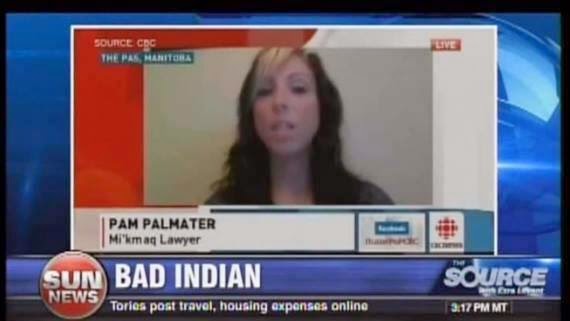
    Dr. Pamela Palmater (Chair in Indigenous Governance, Ryerson University, Department of Politics & Public Administration, As an Individual)*  Thank you for inviting me here today to speak. I want to first acknowledge that we’re on the traditional territory of the Algonquin Nation and that’s not just the polite acknowledgement. That’s the very reason why all of you get to sit here today. Were it not for the cooperation, generosity, kindness, and political alliances, Canada wouldn’t be what it is. Were it not for the peace treaties between our nations that are now constitutionally protected and form part of the foundational aspect of Canada, none of us would be sitting here today. I think that goes to the very heart of Bill C-51 and why I am opposed to it. Canada has placed Bill C-51 before indigenous peoples without any information, analysis, details on how it will impact our nations, any consultation, information or consent from our part. It is a gross violation of our nations to nation relationship. I don’t have time to go through all of the technical legal details and problems with this bill except to say that I echo all of the concerns that have already been brought and will be brought by the thousands of lawyers in this country, security experts, former prime ministers and former Supreme Court of Canada justices. My main concern is how this bill will impact me, my family and indigenous peoples all over Canada and our treaty partners, other Canadians.   Canada has a long history of criminalizing every aspect of indigenous identity. From the scalping bounties in 1949, which nearly wiped out my Mi’kmaq Nation, to the Indian Act, which has outlawed our culture, our right to educate our own children, and even excluded indigenous women from our communities. Every aspect of our identity has been criminalized, both historically and continues into present day. In every single instance, we’ve had to resist all of these laws, keeping in mind these were all validly enacted laws. It was legal to take Mi’kmaq scalps; it was legal to confine us to reserves; it was legal to deny us legal representation. All of these things were law in Canada. We had to be criminals as in, we had to break the law in order to preserve our lives, our physical security, and our identities. We are being faced with this very problem again with Bill C-51. Over the years, these laws have morphed into provincial and municipal regulations that deal with even our traditional means of providing subsistence—hunting, fishing, gathering have all been so criminalized for indigenous peoples that we end up skulking around in the forest just to be able to provide food for our families. Every single court case that has been won at the Supreme Court of Canada has been a battle between indigenous peoples trying to live their lives and exercise their rights and identities facing some kind of criminal or regulatory charge. In every single instance, we have been labelled as criminals, treated as criminals, and one need only look at the current prison population to understand that this is still the case; not just the case, but as Howard Sapers, from the Office of the Correctional Investigator, has indicated, a “national crisis and embarrassment.” And why? Not because we’re actually terrorists; not because we’re more culturally predisposed to being criminals, but as a direct result of Canada’s discriminatory laws and policies. There have been endless justice inquiries, which have pointed to the infection in our Canadian justice system of racism. The Donald Marshall wrongful prosecution inquiry, the Manitoba justice inquiry, the Ipperwash Inquiry, say that every aspect of our justice system, from the arresting officers, to the lawyers, to the judges, to the prison systems, overtly and systemically discriminate against indigenous peoples. That’s our current reality. Bill C-51 proposes to take that to the last and final step. All we have left now, as indigenous peoples are our thoughts. Our private thoughts will now be criminalized. It will now be possible to be considered a terrorist for storing alleged terrorist propaganda on our own personal computers. My declaration of sovereignty, and I’m going to say it before Bill C-51 passes, I’m part of the sovereign Mi’kmaq Nation. That kind of material on my computer could be considered terrorism, a threat to national security because it’s a threat to Canada’s sovereignty. Welcome to the new terrorist. My name is Pam Palmater. I’m a lawyer, I’m a professor, I’m a mom, and I’m a social justice activist. I’ve won numerous awards for my work in social justice, women’s equality, and children’s rights but depending on whose radicalized view you speak of I have also been called a radical, bad Indian, eco-terrorist, enemy of the people, top-five-to-fear Canadian, dangerous militant, and Waco extremist. My biggest concern isn’t how I’m presented in the media or by government officials, I’m stronger than that. My biggest concern concern is how this impacts me right now, the level of government surveillance for a law-abiding, peaceful, social justice activist, who’s never been arrested or convicted of any crime. In my ATIP to CSIS they explain that they have a right to prevent subversive and hostile activities against the Canadian state which is why they have a file on me. However they don’t offer me the courtesy of saying why I would be considered subversive or hostile, in fact everything I do couldn’t be more public.   In my ATIP to Indian Affairs they would not confirm that they monitor me. However they said they do conduct an analysis of me and my activities because I’m an active voice. That analysis comprised 750 pages of documents which tracked all of my whereabouts, what provinces I was travelling to, where I was speaking, and the dates and times. However they could not provide my security file because it was destroyed. When I attend gatherings, rallies, protests, or public and private events I often cannot make cell phone calls, send texts, or access my social media, my bank cards, or my credit cards. I can be at an Idle No More rally or protest and text my children but I cannot communicate with the very chief who has the same protest. This causes me great concern for my safety. How am I supposed to help ensure the comfort and safety of the people at rallies and myself if I can’t communicate with anyone…and I don’t have to remind this committee the staggering statistics and vulnerabilities of indigenous women in this country. I contacted the RCMP as well. They never responded to my ATIP, however individual RCMP officers at various events have confirmed that they were there to monitor me. At numerous protests I have been informed by RCMP and provincial police that I had to keep my protest peaceful. Sometimes they didn’t identify themselves. At speaking engagements the host first nation would demand that any undercover RCMP, or Ontario, or other police officers identify themselves and in many cases they did. What’s more concerning is the number of government officials that follow me around from speaking engagement to speaking engagement and often identify themselves when called upon to do so. Probably the most shocking is when I travel internationally in countries like Samoa, Peru, England, and Switzerland only to be informed by local authorities that Canadian officials are there to monitor me. That’s very frightening in a country where I have committed no crime, but to advocate peacefully on behalf of my people. In the Prairie provinces the RCMP are very active. They will often call ahead to the University of First Nations where I’m speaking and ask them to identify what my target will be or where I plan my protest. This isn’t just a problem for me. We’ve all heard about Cindy Blackstock and others. Skipping of course to what my recommendations are because I can see that I’m out of time. Bill C-51 must be withdrawn there is no way to fix it. There must be proper public information consultation, specific consultation for indigenous peoples, and a proper parliamentary study. Directing Justice Canada to rubber stamp the bill is compliant even if it has a 95% chance of being overturned in court is not democratic. We need an independent review body to report on the ongoing surveillance of indigenous peoples that will take complaints, do proper investigations, and offer redress. Finally, we’re in desperate need of a special first nation advocate to be appointed for any and all court processes in all provinces and territories whenever applications are made in secret for court warrants. This person would be an amicus, a friend of the court who would be independent and can speak to all of the various constitutional and indigenous rights at stake. This is absolutely essential especially if Bill C-51 is to be passed. The Chair: Fine thank you very much, Ms. Palmater. *Taken from: Standing Committee on Public Safety and National Security Committee Meeting March 24, 2015 – Evidence #57 – Unedited Transcript Copy provided by House of Commons Canada.

  • Genocide? Murder? Criminal Negligence? Or Passive Indifference? Canada is Killing Our People

    Racism doesn’t just hurt our feelings – racism kills. The two senseless deaths of First Nations children in a house fire in Makwa Sahgaiehcan First Nation in Saskatchewan from an unpaid bill of less than $4,000 has sparked outrage across Canada. In no other place in Canada would an ambulance, fire fighter or police officer ask a provincial resident if they had paid their taxes before answering an emergency call for help. Canada has a deep-seated racism problem which is killing our people. But to truly understand Indigenous outrage and sadness, one must understand both the context and true depth of this problem in Canada.

    In the mid-1700’s, colonial governments in what is now Nova Scotia considered the Mi’kmaw Nation to be “rebels” because we refused to give up our land. As a result, Governor Cornwallis issued a scalping proclamation that decimated the Mi’kmaw Nation by as much as 80%. In 1971, Donald Marshall Jr., was sentenced to life in prison for murder and spent 11 years in jail before his wrongful prosecution was exposed. A subsequent Royal Commission found the reason for his imprisonment was racism against Mi’kmaw people by all levels of the justice system.

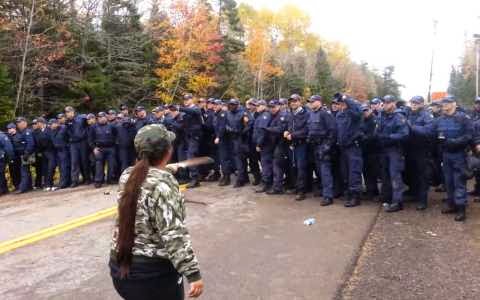
    In 1999, the Supreme Court of Canada confirmed that the Mi’kmaw right to fish and trade it commercially was protected in our constitutionally-protected treaties. The result? Canada sent in law enforcement to beat, pepper spray and run over our fishing boats – in addition to legal charges. In 2013, Elsipogtog First Nation and other members of the Mi’kmaw Nation who supported their anti-fracking stance in Mi’kmaw territory were labeled “terrorists”, “militants” and “bad Indians”. The scalping law was not used but our people were beaten and imprisoned.

    From small pox blankets and scalping bounties to imprisonment and neglect – Canada is killing our people and Canadians will be next if nothing is done to change the value (or lack thereof) that we collectively put on human life – all human life. This dictatorial, police state is not what newcomers to Canada had in mind when they came to Canada. A territory shared with Indigenous Nations based on formal agreements (treaties) and information agreement (alliances) were founded on three principles: (1) mutual respect, (2) mutual prosperity and (3) mutual protection. Indigenous peoples, their families, communities and Nations protected and cared for newcomers. Our people fought in Canada’s world wars to protect our shared territory and people. Now it’s time for Canadians to stand up for Indigenous peoples.

    In 1971, Helen Betty Osborne was kidnapped and murdered in The Pas, Manitoba. Her grieving friends and family were treated like criminals while the accused men were given the royal treatment by law enforcement and left to walk free for years. This wasn’t the first time our Indigenous women and little girls have been victims of a racist Canada, but no action was taken. Today, Canadians are well aware of the thousands of Indigenous women and little girls have gone murdered and/or missing in Canada. Yet, there is no sense of alarm in Parliament, nor has the Canadian state taken any steps to work with First Nations to embark on an inquiry or implement an emergency action plan.  

    By 1996, the last residential school had closed which was supposed to mark an end to the theft of Indigenous children from our Indigenous families, communities and Nations. Literally thousands of Indigenous children were victims of murders, rapes, tortures and medical experiments – and upwards of 40% never made it out of some of those schools alive. The legacy of thousands of our children who died as a matter of state law and policy should at least have included a promise to stop stealing our children. Today, we have more than 30,000 Indigenous children in care and growing. The problems have not stopped – they are getting worse.

    The use of small pox blankets on our people to try to kill us off faster has been described by medical doctors as the first example of “biological warfare” during non-war times. Indigenous women and little girls were forcibly sterilized without their knowledge and consent for decades in an effort to stop us from reproducing. The Canadian state does not need to use such blatant policies to reduce our populations anymore – willful neglect has the same lethal effect. Federal, provincial and municipal governments are standing by while our people die. This is not an “Indian problem” – this is a Canadian problem that impacts every single Canadian and our collective future.

    In 2005,  Jordan River Anderson, a little boy from Norway House Cree Nation with many medical issues, died in hospital at 5 years old never having seen his home because the federal and provincial governments couldn’t stop arguing over who would pay. In 2008, Brian Sinclair, a double amputee, whose family had roots in Berens River and Fort Alexander First Nations, died after waiting 34 hours in a hospital waiting room waiting for treatment for a bladder infection – while nearly 200 people passed him by – including staff who wrongly assumed he was “sleeping it off”.

    The former Auditor General for Canada raised the alarms about discriminatory funding and the failure by Indian Affairs to take action on programs that would significantly impact the lives of First Nations. The Office of the Correctional Investigator has called the increasing over-representation of Indigenous peoples a crisis that needs to be addressed. The United Nations Special Rapporteur has made numerous recommendations on how Canada can address this multi-faceted crisis in First Nations. But Canada fails to take action.

    Despite Canada’s failure to act, First Nations continue to try to raise the alarm bells on this lethal situation. A failure to address the chronic underfunding has led to First Nations being 10 times more likely to die in a house fire than Canadians. Indian affairs own report done in 2011 indicated that a minimum of $28 million dollars was needed to prevent deadly fires in Manitoba alone – yet all 633 First Nations in Canada only get $26 million.

    Canada sits back and watches our people die needless deaths while we struggle to heal our families and communities, to rebuild after the theft of our lands and resources and to resist ongoing attempts to assimilate and eliminate us. The herculean effort at the grassroots level to protect our people is made more difficult by state propaganda that would blame us for our own misery, or deflect media attention by vilifying our leaders. Now Bill C-51 will make those of us who speak out against such inhumanity all “terrorists”. Then who will defend this territory?

    The Chief Coroner for Ontario released an especially rare and powerful report in 2011 on the child suicide epidemic in Pikangikum First Nation which had declared a state of emergency – a desperate call for help that went unanswered by Canada. Within a two year period between 2006 and 2008, 16 children between the ages of 10-19 committed suicide. 16 children died – not from accidental car crashes or unpreventable diseases but because the “basic necessities of life are absent” in Pikangikum who struggles to heal and survive amidst the “backdrop of colonialism, racism and social exclusion” and government neglect.

    16 little First Nation children committed suicide because the Canadian state creates and maintains the conditions of life that will either kill them or make them so hopeless they will kill themselves. That’s the UN definition of genocide.

    In the words of the coroner, this “was not a story of capitulation to death, but rather, a story of stamina, endurance, tolerance, and resiliency stretched beyond human limits until finally, they simply could take no more.”

    In what vision of Canada are the ongoing deaths of our people ok? We need Canadians to stand beside First Nations and support us as we defend the health of our lands and waters as well as the rights and freedoms of Canadians. This should not be our burden to bear alone anymore. Help us turn this ship around before we lose any more precious children.

    #StopBillC51 #RacismKills #Genocide #FirstNationsLivesMatter #foodfor7gens #mmiw P. Palmater, Genocide, Indian Policy and legislated Elimination of Indians In Canada (2014) vol.3, no.3, Aboriginal Policy Studies 27-54. http://ejournals.library.ualberta.ca/index.php/aps/article/view/22225/pdf_22 P. Palmater, Stretched Beyond Human Limits: Death by Poverty in First Nations (2011) No.65/66, Can. Rev. of Social Policy 112-127. http://pi.library.yorku.ca/ojs/index.php/crsp/article/viewFile/35220/32057

  • Bill C-51 The Anti-First Nation, Environmentalist, Scientist and Bird-Watcher Act

    Bill C-51 The Anti-First Nation, Environmentalist, Scientist and Bird-Watcher Act


    Prime Minister Harper’s Conservative government has introduced Bill C-51 The Anti-Terrorism Act, 2015 which it claims is needed to protect Canadians from terrorism. Experts and commentators have called the bill, which will create a secret police force for Harper: terrifying, illegal, unconstitutional, dictatorial and totalitarianism. In case you don’t know what totalitarianism means, it’s a term usually reserved for fascist (extremist or dictatorial) leaders that lead a centralist government that does not tolerate differences of opinion and tries to exercise dictatorial control over many aspects of public and private life – including thought. Voila: Bill C-51.


    The media reports that the Liberals and NDP have all but acquiesced to the bill and will only offer mild resistance in the form of suggested amendments. They may even call for some oversight, but will not challenge the massive violations of Canadian rights, liberties and freedoms which are enshrined in the Canadian Charter of Rights and Freedoms and constitutionally protected. And this is how it happens. Dictators throughout history have only been able to do what they did to their citizenry because they were permitted to do so. No single man has the power to destroy a country governed by the people for the people – unless the powerful people around the dictator allow it to happen.

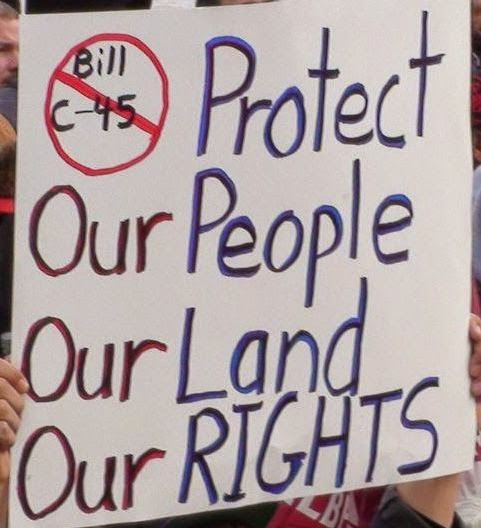
    In a world where Canada used to pit environmentalists, scientists, doctors, teachers, and even bird-watchers against First Nations who peacefully defended their lands, Idle No More helped bring us together. As treaty and territorial allies, First Nations and Canadians face a formidable foe and threat to our collective futures. Idle No More raised awareness about the break down in democracy in general and human and Aboriginal rights specifically. Hundreds of thousands of people across Canada rose up against Bill C-45 – the large, unconstitutional omnibus bill pushed through Parliament without debate which threatened our lakes and rivers. This time, the threat is personal – any one of us could go to jail for thinking or voicing our opinions.


    I originally hesitated to include this chart in my blog, but I think we all need a reminder of the freedoms upon which Canadian democracy rests – for without them, Canada descends into the lethal, dark hole of a deadly, dictatorial police-state.

    CHARTER

    RIGHTS, FREEDOMS or LIBERTIES PROTECTED

    2(a)

    Freedom of conscience and religion


    2(b)

    Freedom of thought, belief, opinion, expression


    2(c)

    Freedom of peaceful assembly


    2(d)

    Freedom of association


    6

    Right to enter, remain in and leave Canada


    7

    Right to life, liberty and security of the person


    8

    Right to be secure against unreasonable search or seizure


    9

    Right not to be arbitrarily detained or imprisoned


    11(b)

    Everyone charged with an offence: right to be tried in a reasonable time


    11(d)

    Everyone charged with an offence: innocent until proven guilty


    15

    Everyone is equal before and under the law


    25

    Charter can never be interpreted to deny Aboriginal & treaty rights


     http://laws-lois.justice.gc.ca/eng/const/page-15.html

    All of these rights, freedoms and liberties will be suspended with Bill C-51. This bill creates what has been described as Harper’s “Secret Police force” with terrifying expanded powers. The purpose of the bill is to eliminate any “threat to security of Canada” which includes any activity that undermines the sovereignty, security or territorial integrity of Canada. It also includes some of the following:

              interference with the administration of justice;

              interference with diplomatic relations;           the economic or financial stability of Canada;           terrorism; and           interference with critical infrastructure. .

    http://www.parl.gc.ca/HousePublications/Publication.aspx?Language=E&Mode=1&DocId=6932136


    The specific powers granted under the bill greatly expand the powers of CSIS (Canadian Security Intelligence Service) from an organization that collects and analyzes information related to security – to one which can take law enforcement action. They are further empowered to take measures against anything they deem to constitute a threat to Canada – inside or outside of the country. Additional anti-terrorism powers under the bill include:

              Materials deemed to be terrorist propaganda can be seized or removed from a website;           Standards of investigation and arrest will be lowered from proof to suspicion;           Police may arrest someone if they merely “think” that a terrorist act “may” be carried out; and           Deny air transportation to anyone who they “suspect” may be engaging in terrorist activity.

    According to security law experts like Craig Forcese and Kent Roach, this new offence of “advocating or promoting terrorism” is not at all clear and Canadians should be extremely concerned about its conflict with the Charter of Rights and Freedoms. One of their concerns is that it gives the police “substantial and unusually invasive powers” to be exercised under their own discretion. A significant change from offences against the promotion of hatred, is the fact that anti-terrorism applies to statements made in private and implies extensive wire-tapping. They fear this bill will result in “speech chill” – the fear to exercise our right to free speech.

    http://www.antiterrorlaw.ca./


    For First Nations, this completes the circle of criminalizing every aspect of who we are as Mi’kmaw, Maliseet, Mohawk and Cree Nations. When they made it against the law to be a Mi’kmaw person, our population was reduced by 80% for the scalping bounties placed on our heads. When speaking our languages and practicing our culture was considered anti-Canadian, they enacted laws to outlaw our ceremonies and killed upwards of 50% of our children they forced into residential schools. When we refused to die off, they forcibly sterilized our Indigenous women and girls without their knowledge and consent to reduce our populations. Standing by and watching our Indigenous women and girls go murdered and missing was a gross violation of our right to life by the RCMP, provincial police and Canadian governments.


    When we survived, Canada made our traditional way of life a criminal act – hunting, fishing, trapping and gathering became criminal or regulatory offences which landed us in jail, resulted in beatings by the RCMP and/or our gear, vehicles and boats were seized. The defense and protection of what little lands we have left resulted in Canada bringing out the RCMP and army to stop our people. When we drummed and danced in Idle No More, we became the targets of illegal monitoring, publicly vilified and categorized as radicals, militants and terrorists. Now, our very voices, our private discussions and even the defense of our sovereignty is now an act of “terrorism”.


    We warned Canadians, that what happens to First Nations under Harper’s dictatorial regime is just a sign of things to come for Canadians. To Canadians who value their freedoms, the beauty and bounty of our shared lands and waters, and the peaceful right to live the good life as you see fit – everything is about to change. Canadians will, for the first time, be treated like First Nations people – without the protection of their basic rights, freedoms and liberties. Even someone who re-Tweets or reposts a comment made by someone else on Facebook could potentially be captured under this sweeping legislation. Our ideas themselves will now be criminalized. Our private lives and opinions will be invaded, monitored and criminalized. For Canadians, this is a frightening new turn of events that may well override our basic human rights, liberties and freedoms – an end to Canada as a democracy as you’ve known it.

    Our decades long experiences with murdered and missing Indigenous women and girls, Starlight tours and the deaths of our Indigenous men while in police custody, the wrongful shootings of our unarmed peaceful protestors, the over-imprisonment of our Indigenous men and women, and the palpable fear many of us have of law enforcement will be part of the Canadian reality unless we stop this Bill now. We are allies in this territory. First Nations fought alongside Canadians in many wars to protect these lands. We lived up to our treaty obligations to protect you and be your allies. Now it’s time for Canadians to stand up and restore this treaty and allied relationship – and protect our collective rights.

    Canada has violated First Nations’ constitutionally protected Aboriginal and treaty rights and basic human rights for decades. If we do not stand together now, this is what Canadians have to look forward to for their children. Please act to stop Bill C-51 now – before it becomes an act of terrorism to even speak about.


    #stopBillC51 #rise #standup #idlenomore #INM #mmiw #foodfor7gens


    *pictures linked from Google Images – copyright rests with individual sites.