Ok, so it’s been four months since the Assembly of First Nations (AFN) election for National Chief and the honeymoon period is officially over. I simply can’t stay silent any longer about where we are and where we are headed as First Nations. If we don’t take action now, even if that means speaking out and risking unity, then it is our First Nations citizens on the ground who will be the ones who continue to suffer from our political inaction. Harper’s aggressive actions since the election more than proves Harper’s real agenda – to once and for all eliminate the “Indian problem” – and it’s do or die time for us. http://indigenousnationhood.blogspot.ca/2012/09/harpers-indigenous-manifesto-erasing.html With respect, I take serious issue with any claim that there was “momentum” between Harper and First Nations prior to the Crown-First Nation Gathering (CFNG) that has suddenly withered since the AFN election. There was no momentum on any key issue of importance to grassroots First Nations peoples or First Nation leaders. Every single action Harper is pursuing against us right now, he started well over a year ago. It seems incredulous that NC Atleo would all of sudden decry the flurry of federal legislation being imposed on our First Nations when the majority of these bills were introduced into the House or Senate prior to either the CFNG or the AFN election. Don’t forget, mention of some of these pieces of legislation were made at the CFNG in Harper’s speech – I didn’t hear Atleo say anything about it then. http://www.cbc.ca/news/canada/story/2012/11/15/pol-cp-first-nations-atleo-harper-letter.html Similarly, with the substantial funding cuts to First Nation political organizations and those being implemented now at the individual First Nation level – we KNEW that this was Harper’s plan. This was not a shock to the AFN. The problem was never lack of knowledge, instead it was a complete failure to have a strategic action plan in place. That is not to say AFN could have single-handedly reversed those funding cuts, but for weeks since their announcement they had weak to no response. It is only now that there seems to be some outcry from the National Chief. But outcry or not, where is the plan? http://metronews.ca/news/canada/434784/atleo-pitches-plan-to-move-beyond-indian-act/ This is where things get progressively worse – Atleo’s new “plan” would have us locked into decades-long self-government negotiating processes which would indebt our First Nations by millions of dollars and trap us there, lest we want to be put into third party management for failure to pay. What about the First Nations citizens on the ground? Where is the plan for the current housing and water crisis? Our people need to have at least the basic necessities of life – where are their voices and priorities reflected? True, some First Nations are doing fairly well on some fronts, but we cannot ignore the multiple over-lapping crises right before our eyes. Many of our people are suffering from homelessness, over-crowding, lack of water, sanitation, food insecurity, the theft of their children by child and family services at alarming rates, many murdered and missing Indigenous women and the over-imprisonment of our men, women and youth. How much worse does it have to get before we shift our focus back to our peoples? http://indigenousnationhood.blogspot.ca/2012/10/indigenous-nations-urgent-situation.html Has AFN even thought about what a section 35 agenda would mean? First of all, it is focused on Canadian law and interpreted by Canadian judges. It should be no surprise then that the majority of the Supreme Court of Canada (SCC) cases have followed a very specific pattern: (1) They always specifically or indirectly protect Canada’s sovereignty; (2) They arbitrarily make up new sui generis (unique) law to ensure our rights can squeeze into Canadian law versus any recognition of our own laws; (3) The cases transform First Nations from sovereign Nations and governments to cultural entities frozen in pre-contact times that must be reconciled with Canadian sovereignty; (4) Whenever a principal or finding goes in our favour, it will inevitably be limited, redefined and reduced to an almost unusable right in subsequent cases. Take for example, the Indian priority in Sparrow which came second only after conservation. In Delgamuuwk, our priority sank to last after every other possible priority including: agriculture, forestry, mining, hydroelectric power, environment, infrastructure and settlement. (5) The section itself requires the extensive, costly litigation of our rights on a right by right, species by species and First Nation by First Nation basis. Many of these cases take decades to resolve and even once they hit the SCC, it is not uncommon for them to send the case back to trial. Even then, we are the only group subjected to re-hearings like in Marshall II which substantially altered the original court win. So, what is it about section 35 that offers an alternative to the current situation? Do they not realize that First Nations are the only entities with real sovereignty here? Canada knows this and is desperately buying up the rest of our lands through claims and securing its own sovereignty agreement by agreement. Canada is slowly piecing together their ownership and sovereignty, and some of us are allowing them to do that. I am not saying that they have offered any alternatives, but we don’t have to accept what they thrown down. In order to speed up the process Canada will introduce the First Nation Property Ownership Act so we can surrender the last of our lands. What about any of this is a plan forward? Atleo’s “plan” also calls for a National First Nations Auditor – seriously? That is nothing more than trying to please the government’s obsession with trying to make all First Nations look corrupt.Try selling that as a solution to a northern Ontario First Nation whose school is falling apart; or a flooded Manitoba First Nation whose residents have been displaced for many months; or a Saskatchewan First Nation whose water is contaminated. Who cares about another national First Nation entity which will benefit the CEO, its few employees and serve a relatively minor number of First Nations. Think of the First Nations Tax Commission, the First Nations Statistical Institute, and all those other “national” organizations located in British Columbia. We don’t need a First Nation bureaucracy on top of the massive Indian Affairs bureaucracy we have now. We are not one nation of people – we are many Nations with our own sovereignty(s). We have laws and governance systems which makes us strong Nations. We need to act on that strength, in different ways, in different territories, and according to our own laws and priorities. If we can’t stay focused on living and acting on our sovereignty everyday, then we’ll be easily led down the colonizer’s path of chasing “equality”, “section 35”, and other government carrots – while missing the war going on around us. Make no mistake, our peoples are the casualties in this war and things are growing steadily worse on all socio-economic fronts. The status quo is killing our people and has been for quite some time. The problem is that Harper has changed the status quo and things are about to get much worse. http://pi.library.yorku.ca/ojs/index.php/crsp/article/viewFile/35220/32057 Unbelievably, the AFN only now appears to be realizing that Harper’s full-blitz attack on First Nations has some “potential for harmful impacts”. This means that nationally, we are way behind in this war. The AFN has had many opportunities to take a stand over the last few years and has failed to do so each time. That is not to say that individual regions or First Nations have not been raising the alarm bells – in fact, some had to very publicly withdraw from Atleo-Harper education plan in order to preserve their treaty and inherent rights. There are also thousands of First Nation community members who want to see their leaders lead and are willing to stand behind their Nations – but they need to be inspired to action. There can be no more delays – we need action. Our peoples deserve better than our fear, hesitancy and wilful blindness to their suffering. We cannot chase Canada’s section 35 illusion with eyes wide shut. Harper is presenting us with a false choice: Indian Act or assimilation and some of us have fallen into the trap of letting him define our options. We need to take stock of where we have been, the situation we created by allowing this to happen, own it, and move forward. None of us as individuals have all the answers – but we are lucky, we still have the strength of our collective Nations to stand beside us. Let’s do this for our peoples and our Nations. “When it comes to confronting our imperial realities some of us want to reform colonial law and policy, to dull that monster’s teeth so that we can’t be ripped apart so easily.” “Some of us believe in reconciliation, forgetting that the monster has a genocidal appetite, a taste for our blood and would sooner tear us apart than lick our hands.” “I think that the only thing that has changed since our ancestors first declared war on the invaders is that some of us have lost heart against history and against those that would submit to it.” “I am with the warriors who want to beat the beast into bloody submission and teach it to behave.” (Excerpt from: Taiaiake Alfred, Wasase: Indigenous Pathways of Action and Freedom (Toronto: University of Toronto Press, 2005).
Year: 2012
-
Bill S-2 – Family Homes on Reserve and Matrimonial Rights or Interests Act
Harper’s Conservatives have given the signal that they may, once again, refocus their legislative eye on Bill S-2 Family Homes on Reserve and Matrimonial Interests or Rights Act (otherwise known as the MRP bill). To this end, the parties have been preparing to study the bill and hear from witnesses on possible amendments.
Bill C-428 Indian Act Amendment and Replacement Act
Bill C-27 First Nations Financial Transparency Act
Bill S-2 Family Homes on Reserve & Matrimonial Interests or Rights Act
Bill S-6 First Nations Elections Act
Bill S-8 Safe Drinking Water for First Nations Act
This does not include any of the omnibus or other bills which impact First Nations. There are two others bills expected to be introduced in the New Year as well:
First Nation Education Act
It would be almost impossible for First Nation community members to know what these bills are really about simply by reading the titles of the bills. The Conservative Party is very good at using titles for their bills which betray what the bill actually does. Bill S-2 is a prime example of a bill that is being promoted as one which will protect Indigenous women from domestic violence and “give” them equal rights upon marriage or relationship breakdown. This bill does neither of those things.
(2) The bill views First Nations peoples as “cultures” versus to governments with their own jurisdictions or Nations with their own sovereignty.
– They apply to all First Nations until they enact laws pursuant to the bill;
– Non-Indians will be able to gain rights (exclusive occupation, life interest, etc) to the home and contiguous land on reserve;
– A judge can make a ruling that violence has occurred and bar that person from the house, without the alleged offender being charged or convicted;
– First Nations are not entitled to notice for emergency protection orders which give possession to a house and land to non-Indians;
– Certificates of Possession can be forcibly transferred from one First Nation spouse to another; and
– A person who is not member/Indian, can apply to have order enforced as though he/she was member/Indian.
Without getting into too much technicality, this bill either conflicts with or violates various Canadian laws:
(1) Bill S-2 conflicts with the Indian Act – The Indian Act reserves land for the exclusive use and benefit of Indians and make it an offense for non-Indians to trespass on reserve, yet Bill S-2 creates new rights for non-Indians on reserve;
(2) Bill S-2 is outside is outside Canada’s legislative authority in section 91(24) of the Constitution Act, 1867 – This is because Canada is purporting to legislate with regard to the property and civil rights non-Indians which is the exclusive jurisdiction of the provinces. Thus, provincial legislation will also be required to make the bill effective.
(3) Bill S-2 violates section 35 treaty rights in the Constitution Act, 1982 – This is because many reserves were set up via treaties, which are now protected in section 35. These treaties are for the benefit of Indians – not non-Indians.
(4) Bill S-2 violates section 35 Aboriginal rights in the Constitution Act, 1982 – This is because the inherent right of First Nations to be self-governing over their own peoples and lands is recognized by Canada as protected in section 35. Yet with this bill, Canada purports to control internal matters even more than they do now.
(5) Bill S-2 represents a breach of Canada’s honour, its fiduciary obligations and its legal duty to consult and accommodate. Bill S-2 was drafted without First Nation input, there were no legal consultations, and the bill will result in more federal control, not less.
(6) Bill S-2 violates many articles of the United Nations Declaration on the Rights of Indigenous Peoples (UNDRIP) – including:
Art.3 – the right to be self-determining;
Art. 4 – the right to be self-governing over our own internal affairs;
Art. 19 – the right of free, informed and prior consent before ANY legislative measures that affects us; and
Art. 37 – the right to recognition and enforcement of our treaties.
Some of the other key concerns that have been raised by witnesses who have testified previously include the lack of access to justice as all remedies must be access through courts, no funding is provided for accessing legal services, and many communities don’t have local access to courts. The issue of housing on marital breakdown is further complicated by Canada’s refusal to address the housing crisis or provide adequate funding for shelters.
There are many other issues not outlined here in order to keep this blog simple. However, I will be publishing a more detailed analysis of both direct and indirect impacts of this bill.
-
National Chief Manny Jules: Shared Priorities, Self-Sufficiency & Other Policy Myths
Indian and Northern Affairs Canada’s (INAC’s) recent round of cuts to national Aboriginal organizations, regional First Nation organizations and tribal councils are very telling about the policy direction in which we are headed. This policy direction is most definitely backwards in time – say 50 to 100 years or so. Canada has come nearly full circle in its treatment of Indigenous peoples. Canada went from (1) creating a mythic “race” of Indians to be divided, controlled and assimilated, (2) to recognizing (at least somewhat) that First Nations are diverse, have the inherent right to be self-determining (although limited) and that Aboriginal and treaty rights must be addressed (even though we didn’t agree on how), (3) back to treating all “Indians” as one big problem that needs to be eliminated. http://indigenousnationhood.blogspot.ca/2012/09/harpers-indigenous-manifesto-erasing.html The two major policy objectives of this Harper government have been clear from the very beginning – it is about getting rid of Indians once and for all and turning Canada into one massive extractive industry. Harper is trying to position himself as a world power and he needs our land and resource treasury to do that. If there is one thing you can guarantee about power-mongers is that social justice, the rule of law and consideration for future generations is not consistent with world domination. Harper may have some competition if Mitt Romney is elected as President in the United States, but that is another disaster for another day. http://indigenousnationhood.blogspot.ca/2012/08/pinky-and-brain-comeback-mitt-romneys.html INAC has always used a system of financial rewards and punishments to try to force First Nations into certain policy directions. This is not an easy task. It requires a colossal bureaucracy at INAC to control First Nations, manage their expectations and steer them in the direction which suits the Minister of the day. When you take a Nation’s land, resources and citizens away, then use all the profits to sustain your ever increasing bureaucracy and other pet projects (militaries, submarines and fighter jets) then that Nation is essentially held at ransom. Most, if not all First Nations have at least some citizens who need to eat, access clean water, and have safe, warm housing. If you hold access to those basic human needs over the heads of leadership, their practical choices become quite limited. http://pi.library.yorku.ca/ojs/index.php/crsp/article/viewFile/35220/32057 By keeping First Nations chronically under-funded for all essential human services, they will always be subject, at least in some way, to undue pressure by INAC’s bureaucracy. In some cases, the extent of the poverty is so severe that the situation goes from one of undue duress to what some have called “extortion” (obtaining money or property from someone through coercion, commonly practiced by organized crime). If you bring people to the brink of starvation, disease and hopelessness in order to get their agreement to give up their rights, how is this not at least undue duress? http://www.timescolonist.com/business/Housing+still+major+issue+First+Nations/7139121/story.html Harper’s plan is very clear – eliminating all history, obligations and mention of First Nations from Canada. His former advisor, Tom Flanagan, has tried for years to sell the idea of reinvigorating attempts to assimilate Indians and get rid of reserves, treaty rights and any form of distinct identity. The very racist, derogatory language and ideologies used to try to promote assimilation prevented a much wider audience from listening. Now, with the “new” more fringe right-wing Conservatives in power, they have adapted their tactics. People like Flanagan and Harper use First Nations people to sell their wares now. From Conservative Senator Patrick Brazeau who acts as Harper’s mouth piece tearing apart First Nations at every chance he gets, to Manny Jules, head of the First Nation Tax Commission who now promotes the destuction of reserves and the biggest assimilation policy plan created in recent years: the nationalizing of First Nations. http://reviewcanada.ca/reviews/2010/04/01/opportunity-or-temptation/ One need only look at INAC’s recent announcement to see exactly where they get their authority to cut funding to First Nation organizations, the ideology they are using, what their ultimate objective is, and who is benefitting (aka leading the charge). First off, INAC is focusing on what they call “self-sufficiency” which means First Nations that are self-funded. This is ironic, given that all Canadians are funded off the wealth and profits that come from our lands and resources. Were it not for our gas, oil, minerals, fishery, forestry, rivers, trade routes and lands, Canadians would not have such a high standard or living nor would government have the funds to pay for health, education and other services for Canadians. Taxpayers don’t pay our way, we pay THEIR way and we are kept in starvation mode for it. http://www.aadnc-aandc.gc.ca/eng/1346805886381/1346805926370 So, we know that their ultimate objective it to eventually cut all funding to First Nations and their political organizations and Canada will do this in a dramatic, albeit staged approach. No surprise here, we knew this was coming. The AFN has been woefully inactive on this front hoping the issue would simply go away. Well, it hasn’t and it’s here and we have to face it. INAC’s ideology is also telling – they want to treat all First Nations the same. Regardless of what region, treaty area, territory or Nation we are from, INAC will fund everyone the same. INAC is back using the concept of treating us all as one mythic race of Indians and what is good for one is good for all. We all know that northern communities are not in the same position as those in the south. The poverty levels vary across the country as do the housing crisis, flooding crisis, suicide crisis, water crisis, food insecurity crisis, and education, advocacy, and governance capacities. Mohawks have different laws, rules, cultures, languages and trade systems than do Mi’kmaq, Cree or Anishinabek. Some of us have treaties and others do not. There never was one race of “Indians” and to treat us like that in terms of funding ties our identities to federal laws, policies, recognition systems for one reason only – assimilation. In other words, they legislate who we are, who gets to be us and when we no longer exist. The funding cuts will just help this process along. Provinces and territories ought to take notice as well. Look at how Canada purports to change the constitutional jurisdictional relationship in section 91(24) from “Indians and lands reserved for the Indians” to “only Indians that live on a reserve”. For many communities, this will cut funding even more severely than can be seen in the announcement. First Nations will be assessed based solely on their on-reserve populations, which for many is about half their population. In other cases, some have 80% of their populations off-reserve, but are still responsible for them in a variety of ways. This is also no surprise as Canada has been trying to figure out how to deal with the inevitable court cases which find Indian status (registration) rules to be discriminatory. Their idea to reduce financial obligations is to slowly and quietly transition to an on-reserve population funding model versus a total band membership model. In the announcement, INAC explains that future funding will be based on “our shared priorities”. In case you are wondering where they got their shared priorities one need only refer back to the Crown-First Nations Gathering (CFNG) and the AFN-INAC Joint Action Plan which came out as a result. Harper was very clear in his speech that he would be getting rid of “incentives” (aka funding) and promoting “individuals” (aka breaking up reserves). The whole speech was designed to promote “integration” (aka assimilation). Harper said he would impose a suite of legislation and he is keeping his promises. There should be no shock about what is happening – the only issue is how we deal with it. In this case, the AFN opted to sign a Joint Action Plan, without the consent of the different regions in Canada to do exactly what Harper outlined. http://indigenousnationhood.blogspot.ca/2012_02_01_archive.html This is why INAC now says that they will limit funding to “shared priorities”. Let’s compare Harper’s Speech at the CFNG with the AFN-INAC Joint Action Plan and INAC’s Shared Funding Priorities:
CFNG Gathering Speech
INAC-AFN Joint Action Plan
Shared Funding Priorities
Treaty relationship
Meaningful dialogue on treaties
Consultation on resource development projects (omnibus bill to remove consultation, funding cuts to advisory services)
Change rules in education
National education panel to discuss legislation
Education (education legislation, funding cuts to organizations and for proposal-based program funding)
Change FN accountability
Accountability of FN governments
Governance (accountability legislation, elections legislation, funding cuts to governments, political organizations, advisory services)
Focus on economic development
Unlocking economic potential
Land management (reserve privatization legislation, funding cuts for advisory services, community plans)
Obviously, this is a very brief overview of several detailed documents and is meant in a very general way. Any policy or legal analysis of these documents would be much more sophisticated than can be reasonably presented in a blog (my blogs are already too long). All this to say, that INAC wants First Nations to “seek out new funding sources”. Easy for INAC to say because they have already taken 99.8% of our lands, most of our resources, and many of our people. What would these new funding sources look like? Well, one can imagine corporations like Enbridge and other pipelines, oil and gas companies, hydro companies, mining companies, nuclear or waste disposal companies and others would be a perfect fit.
Canada privatizes our reserves + First Nations need to provide food, water and housing to their citizens = sale of our remaining lands to Enbridge et al.
Just in case First Nations are unsure about how to proceed, they will no longer have funding for organizations to provide advisory services in the areas of economic development, financial management, community planning or governance. But that’s ok, because there is a new National Chief in town, and his name is Manny Jules. Manny Jules and his national organizations will solve all Indian problems – you will have your choice of: (1) Taxes (a) First Nation Tax Commission (Manny Jules) imposing tax regimes on your reserve or (b) Reserve lands becoming provincial lands subject to provincial taxation; (2) Finances (a) First Nations Financial Management Board (Harold Calla) manage your community’s finances or (b) Third party management by any number of high-priced financial consultants (except your own); (3) Economic Development (a) Aboriginal Economic Development Board (Clarence Louis) will advise INAC on how best to develop your reserve lands or (b) INAC will unilaterally unlock your lands and then develop them for you; (4) Reserve Lands (a) First Nations Land Title Institute (Manny’s proposed idea) will take over your reserve lands or (b) Find alternate funding to support your First Nation when INAC cuts all funds; (5) Governance (a) Allow your First Nations to be subsumed under one National Aboriginal Organization or (b) Have all of your political, advisory and governance funding cut by INAC. These are the choices being presented to First Nations by Canada: assimilate or stay on the rez. It is a false choice of course, because there are so many more meaningful options which come from our traditional ways of governing, learning, trading, sustaining, and relating. The hardest choice of all will be deciding to do things differently, doing things our way, and making the necessary short-term sacrifices to ensure the long-term future for our children. This is a sign of things to come – they will cut funding to First Nations even more. They will amend the constitution, they will breach and even try to extinguish our rights and they will do their best to assimilate us. We all own this – we all have a responsibility to make the changes we need. If we don’t care enough about our families, communities and Nations to at least try – no one else will. No one says it will be easy, in fact, I can guarantee it will be hard. We have a lot of work to do to gain back the faith and loyalty of our citizens and conversely, our citizens have work to do in supporting their Nations. We have a lot of issues to deal with internally, but that is our conversation to have amongst ourselves. The frustration of grass roots peoples with their leaders and organizations is very real and must be addressed. The frustration of leaders with Canada and the over-whelming task of trying to solve all the problems alone is also very real. The issue which faces us is not a battle between traditional leaders and Indian Act leaders, between men and women, or between on and off-reserve. The colonizers have done a good job of dividing us, confusing us and aligning us along their own ideologies about class, status, and individualism. If we could forgive ourselves for being colonized and for struggling with decolonization and healing, then the space would open up to work on this problem. We can let Canada’s plan unfold or there is a place where our peoples can meet in the middle, start over, face the problems honestly and openly, and start the healing journey towards changing our communities for the better.
-
Harper’s Indigenous Manifesto: Erasing Indigenous Peoples from Canada
Early Indian policy was designed to accomplish two main policy objectives: (1) acquire Indigenous lands and resources, and (2) reduce financial responsibility to Indigenous peoples. The primary way in which these two objectives were to be achieved was through the physical, legal, social and spiritual elimination of Indigenous peoples. I say “elimination” because that is the word which best describes government intentions. Most people today use the term “assimilation” but to my mind, this word is much too soft to describe the design and impact of government policies on Indigenous peoples in Canada. To some readers, the term “elimination” may seem a little harsh, somewhat of an exaggeration, or perhaps rhetoric blown out of proportion which forgets the good intentions governments, churches and traders had for Indigenous peoples. I beg to differ – not because I fall into any externally imposed category of left-wing, liberal, radical or “nutbar”. I beg to differ because the facts – the brutal, uncomfortable facts tell us a much different story. My biggest concern is not that the colonization project devastated Indigenous peoples, because the historical record clearly shows it did; it is that the colonization and devastation of Indigenous peoples continues, albeit couched in softer terminology. Today, the few history books that have been amended to include mention of Indigenous peoples speak of the tragic loss of Indigenous cultures over time. They speak of this “loss” as a romantic part of our history where the strong, noble Indian chief on his horse looks across the horizon and realizes that the ways of his people are fading away with the coming of European trains, traders and technologies. This sort of representation may even invoke feelings of melancholy in Canadians who long for the simplicity of the old days. But it belies the truth about Canada and its direct and intentional “obliteration” of Indigenous peoples, cultures and territories. If the term “elimination” does not make some readers uncomfortable, surely the term “obliteration” will. The purposeful destruction of a people implies the kind of ill-intent, even malice upon which a country like Canada could surely never have been built? Terms like those imply that perhaps what happened to Indigenous peoples was not simply “progress”, “civilization” or a “good policy gone wrong” – no, this falls in the realm of a word that usually upsets the majority of readers: genocide. Many people do not understand the legal definition of genocide, nor are they aware of how genocide is considered internationally. Many are of the misunderstanding that genocide is the mass murder of millions of people all in one shot – something akin to the holocaust. In fact, genocide is defined in the United Nations Convention on Genocide as follows: In the present Convention, genocide means any of the following acts committed with intent to destroy, in whole or in part, a national, ethnical, racial or religious group, as such:
- (a) Killing members of the group;
- (b) Causing serious bodily or mental harm to members of the group;
- (c) Deliberately inflicting on the group conditions of life calculated to bring about its physical destruction in whole or in part;
- (d) Imposing measures intended to prevent births within the group;
- (e) Forcibly transferring children of the group to another group.
That is the definition. In Canada and the United States, settler governments have committed genocide against Indigenous peoples, not under just one category, but under every single category noted above. We all know it, but the reality stands in such stark contrast to the mythology created by government about what Canada stands for, that many people resort to denial. Indigenous peoples who have raised the subject have been referred to as “nutbars”, “whackos”, “conspiracy theorists”, “radicals” and “terrorists”. The issue of genocide is radical – not because it is not true, but because it stands so far outside the realm of humanity and human rights that the tendency is to save the term for only the most obvious, horrific, well-known instances of genocide committed in places far away from Canada. http://rabble.ca/blogs/bloggers/pamela-palmater/2011/11/unbelievable-undeniable-genocide-canada The term genocide is usually saved for instances where the victims are considered to be humans – and Indigenous peoples have long been characterized as non-humans for centuries. Aside from the historical depictions of Indigenous peoples as “savages”, “heathens” or “pagans”, they have also been treated by governments as “dangerous and sub-human”. The myth of Indigenous peoples being sub-human allowed governments to steal Indigenous lands under the legal fiction of “terra nullius” (lands belonging to no one). They knew better of course, but it allowed them to justify not only the theft of lands from Indigenous peoples, but the brutal acts of genocide which were committed upon them. The fact that early governments sent small-pox infested blankets to Indigenous communities knowing it would nearly wipe them all out, is a historical fact. These were not the actions of a few bad apples, or something that happened in the stone age. This has been acknowledged as modern “biological warfare” by publications in the Journal of the American Medical Association. The scalping laws in Nova Scotia were deliberate acts of murder which decimated the Mi’kmaw Nation population by almost 80%. The forced surgical sterilization of Indigenous women against their will, and often without their knowledge or consent, destroyed Indigenous peoples in a very physical way. The government and church-run residential schools knowingly created conditions that led to the mass deaths of the Indigenous children who attended – upwards of 40% never made it out alive. Incredibly, not only did government officials know that Indigenous children were dying and even “acknowledged” the high rates of deaths and their causes, but this was part of the overall objective: “But this alone does not justify a change in the policy of this Department, which is geared towards the final solution of our Indian problem.” (SI Indian Affairs, Duncan Campbell Scott) Why do I bring all this uncomfortableness up in my blog? Why am I asking readers to face the brutal reality that is Canada? It is because genocidal acts against Indigenous peoples continue to this day, hidden in government policies which purport to be in the best interests of Indigenous peoples. It is because every government (Libs and Cons) has had a hand in continuing the situation, but mostly because this Harper government has ramped up efforts to eliminate Indigenous peoples. In my opinion, the Harper Indigenous Manifesto is about erasing Indigenous peoples from Canada socially, culturally, legally and physically. What used to be forced sterilizations to prevent child births and control Indigenous populations is now pre-mature deaths from the extreme poverty directly linked to chronic, purposeful under-funding, over-prescription of addictive drugs, and lack of housing, water and sanitation. What used to be residential schools became the 60’s scoop and is now child and family services removing our children from our communities at alarming rates. What used to be European/western education forced on our children through residential schools, is now the provincial school systems, which for the most part, teach the same western ideologies, histories, sciences and politics to our children and specifically exclude our traditional Indigenous knowledges, languages and cultures. What used to be scalping laws, are now starlight tours, murdered and missing Indigenous women by the hundreds, and quelling land claims with brute military and police force. What used to be laws against Indigenous peoples leaving their reserves are now laws which take away rights when one leaves the reserve (taxes, governance, jurisdiction, trade, identity). What used to be laws against Indigenous peoples gathering in one place is now CSIS, RCMP, DND and INAC putting us on terrorist watch lists, monitoring our movements, and over-incarcerating our men, women and youth at increasing rates. What used to be laws against Indigenous peoples hiring lawyers to advocate on their behalf, are now devasting funding cuts to local, regional and provincial First Nation political organizations. All coming at a time when Harper wants chaos, confusion, and lack of political capacity to ensure there is little resistance to his comprehensive Indian Act-based legislative agenda. He hopes to strike fear and confusion in chiefs so that they don’t know whether to stay quiet and hope it doesn’t get worse, or take action. Either way, funding cuts will be imposed on local First Nations as well. This is not about whether regional political organizations are doing a good job or not – this is about Harper fulfilling the original intentions of Indian policy (1) accessing Indigenous lands and resources and (2) reducing financial obligations to Indigenous peoples. He just happens to see striking at political organizations as the best way to isolate individual First Nations, already overwhelmed with issues, so they are easier to bully into submission. The Assembly of First Nations (AFN) either does not have the capacity or inclination to take these issues on. Regardless of the reasons, it is clear that local community members are going to be looking to their local First Nation governments to take action. In the same vein, First Nation leaders will be looking for assistance from their treaty, regional and provincial organizations. The days of waiting for the AFN to do something are over. If these funding cuts are ok, so will be the ones that come to individual First Nations, then will come the eventual constitutional changes, the accelerated extinguishment of Aboriginal and treaty rights, and the division and sale of the rest of our lands. If Canadians think that this does not concern them – they should think again. As your “Canada” slowly becomes a dictatorship led by a rogue Prime Minister who is obsessed with power, Canadian laws, rules, and regulations are breached with impunity. Everything from elections, ethics, budgets, and legislation are manipulated without regard for the rule of law. The damage done by these renegade Conservatives is already so severe that analysts feel it will take years to undo the harm. In standing beside Indigenous peoples to oppose these destructive policies, Canadians would be living up to the spirit and intent of the treaties and, in so doing, protecting their own futures. Economic reports have already shown that the costs of maintaining Indigenous peoples in poverty is higher than the solutions. Those same studies show that the costs of delaying the resolution of land claims and treaty implemention for example, are higher than if those claims were resolved equitably. Even the most basic math shows that it costs more to keep an Indigenous person in a federal prison for one year ($100,000) than it does to pay for a 4-year university degree ($60,000). If you think for a minute that once Harper is done erasing Indigenous peoples, that he won’t come after women, children, the impoverished, the remaining pristine environmental areas, water basins and sanctuaries all in the name of wealth and power, think again. There is no room for justice, diversity or freedom in a dictator’s view of the world. We are all compelled to act. Our reasons do not have to be the same. I can be a Mi’kmaw citizen and someone else can be a Canadian citizen, but still have a mutual interest in protecting the environment. Whether someone votes in federal and provincial elections, or like me, does not vote in elections – we all still share the desire to protect our waterways. One can be Maliseet and someone else French, but still feel it important protect our cultures for future generations. I have no intention of letting Harper erase me, my family, my home community or Mi’kmaw Nation. Let’s put our heads together about a plan of action. Extra sources: http://pi.library.yorku.ca/ojs/index.php/crsp/article/viewFile/35220/32057 http://www.oba.org/en/pdf/sec_news_sept11_c3_palm.pdf http://lawandstyle.ca/opinion_first_nations_fiasco/ http://fusemagazine.org/2012/07/35-3_palmate
-

Mitt Romney’s World Domination Plot…errr Platform
As I watched the Republican convention last night, for just a moment, I thought I was watching an episode of Pinky and The Brain. Remember that kids show, two genetically-altered lab mice who plot to take over the world each night and ultimately fail? Mitt Romney’s speech, although more empassioned than his usual robotic-millionaire self, was just a tad frightening.
Mitt Romney (aka The Brain) and his running mate, Paul Ryan (aka Pinky), are hoping that Americans buy into their bid for the top job as leaders of the United States of America (i.e., take over the world). Their plan is eerily familiar somehow…. can’t quite place it, but sounds an awful lot like a modern version of terra nullius and imperialism 101. http://www.foxnews.com/politics/2012/08/30/transcript-mitt-romney-speech-at-rnc/ First of all, Romney opens his speech with a very telling line: “We’re a nation of immigrants.” True, they are all immigrants. However, they are not a nation – they are a state which is located in and among many Nations – Indigenous Nations. To say that the USA is a nation of immigrants treats the original peoples as though they don’t exist. This is how the colonizers justified the theft of Indigenous lands, because they were terra nullius – “land belonging to no one”, or in other words, no humans were inhabiting a piece of land, so it was free for the taking. Romney also goes on to state “We’re the children and grandchildren and great-grandchildren of the ones who wanted a better life. The driven ones.” Oh, they’re the driven ones alright – there wasn’t anything they were not willing to do to acquire Indigenous lands and resources – from scalpings, mass murders, forced relocations, residential schools, to forced sterilizations. But all of that was justified. Why? Because they came in the pursuit of freedom – “freedom to build a business with their own hands”. In America, they don’t apologize for success”. In fact, according to Romney’s view of the world, “it’s the genius of the American free enterprise system” that has created America as it looks today. Of course, you have to sort of ignore that Indigenous peoples exist, that there are huge societal inequities between men and women, Black and white people, gay and straight, and rich and poor. But that’s ok because according to Romney, his empire… err America, will not “mention their race, their party affiliation or what they did for a living”. Nevermind that this same “genius” free enterprise system is killing our oceans, lands and skies. For every imperialist, there is always an arch nemesis who threatens to foil the world domination plan. For The Brain, it was usually Pinky’s lower IQ that foiled his plans. For Romney, President Obama is the arch nemesis because of his ludicrous non-genius ideas. Obama wants to slow the rise of the oceans… HAHAHAHAHAHA… and he wants to try to heal the planet… BAHAHAHAHAHA! How ridiculous! Obama will never take over the world that way. No, Obama should have a genius world domination plot like Romney which will make the already privileged individuals who vote for him much, much richer. But, as with all good world domination plots, one can’t build an empire without the requisite propaganda which justifies the invasion… err… freedom campaign. The formula for this is simple: “free other nations from dictators”, show other countries “less flexibility and more backbone”, and create a “free world” by imposing…err… promoting “America”s Democratic ideals”. In fact, Romney’s America “will preserve a military that’s so strong no nation will ever dare test it”! No one will ever touch “our oil, our coal, our gas, our nuclear and renewables”! Ok, so that speech is scary! Romney says it’s “time to put aside the divisiveness” and try to create a world where “everyone else on the block is doing the same thing”. Nevermind trying to thrive in your cultures and traditions as Indigenous Nations or protect our delicate ecosystems for future generations. No, if American’s elect Romney, their world domination tour will no doubt start with us and our oil, our gas, our water and our natural resources. All the more reason to stop the pipelines now.
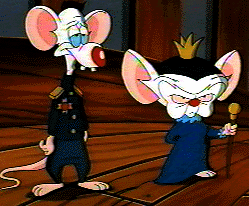
Lieutenant Ryan: Gee Romney, what do you want to do tonight? Emperor Romney: The same thing we do every night Ryan, try to take over the world! *Images used from Google Images.
-
Harder Politics When No Skin in the Game: Time to Address Racism
Is it just me, or is there something about this unusually hot summer that has scrambled the brains of business owners, community groups and politicians? It seems to me that in the last few weeks, I have received no end of e-mails and messages on social media from concerned Indigenous peoples from all over Canada. What is their concern? It’s the fact that in the year 2012, we STILL have Canadians who believe it is acceptable to profit from or completely ignore the blatant racism being perpetrated against Indigenous peoples. Eska Water: Perhaps it is just the heat because last year around this time, I wrote a blog about the discriminatory advertising being used by Eska Water. Their commercial for “pure” water included three men who were a mish-mash of stereotypes depicting Indigenous peoples. When confronted with the racist commercial, a spokesperson defended the company by saying “the depiction was a generic one of native people and not meant to represent any specific group”. What??? http://indigenousnationhood.blogspot.ca/2011/07/eskan-racism-bottled-and-sourced-in.html The depiction was indeed a racist depiction of Indigenous peoples and they did in fact, mean to represent a specific group of people – Indigenous peoples. The fact that none of their non-Indigenous test group identified any problems and in fact offered positive comments about the ad, shows a much deeper problem. Racism against Indigenous peoples in Canada is so ingrained that some in society can’t even identify it when they see it. It is so ingrained in fact, that no one in the company thought to include any Indigenous peoples in the consumer test group. Recommendations: (1) Companies should include a broad cross-section of society in consumer focus groups (this includes Indigenous peoples). (2) Companies should use the multitude of resources available related to human rights, diversity and inclusion to prevent harmful situations of racism and discrimination. Royal Canadian Legion: Less than two weeks ago, it was reported that the Royal Canada Legion in Cranbrook, BC had published a newsletter which included a racist joke about Indigenous peoples. This “joke” was not your usual combo of insulting stereotypes, this one had a hateful undertone which mocked the killing of Indigenous peoples with impunity. http://www.cbc.ca/news/canada/british-columbia/story/2012/08/16/calgary-cranbrook-newsletter-pulled-joke.html The response was that the joke “only offended one person” and that it was meant to “get a laugh”. I can’t imagine a time when a racist joke would be funny, but in no stretch of the imagination is the murder of an Indigenous person funny. Many of our Indigenous peoples lost their lives fighting alongside Canadian soldiers in war. On average, 40% of Indigenous children who entered residential schools never came out alive. Starlight Tours have resulted in countless deaths of Indigenous peoples. Indigenous peoples die pre-mature deaths everyday from conditions of extreme poverty caused by chronic underfunding of essential social services like food, water and housing. This is no joke. Simply removing the joke from the newsletter without a sincere apology and commitment to do better does little to educate their legion members about racism, discrimination and how it impacts all their members. I doubt it did much to make amends for the shock, insult and hurt most likely felt by the Indigenous members of the Legion, as well as other non-Indigenous Legion members who care deeply about the human rights of all members of society. Recommendations: (1) When an organization makes a mistake which hurts 1 person, 3 people or a 1000 people, own up to it, apologize, make amends, and take steps to ensure it doesn’t happen again. (2) Any organization can use this kind of situation as a learning opportunity to educate its members about discrimination, what it is, how it can occur, the harm it does and most importantly, how to prevent it altogether. Holy Chuck: Last week, I was again contacted by my social media contacts, this time about a restaurant in Toronto that allegedly used racist language in their burger menu. When I was sent a copy of the menu and read that one item was called the “Dirty Drunken Half Breed”, I honestly thought it was a bad joke (as in it wasn’t a real menu item). I went online and checked it out and it was indeed an actual menu item. http://aptn.ca/pages/news/2012/08/28/toronto-restaurant-scalded-after-using-slur-for-burger-name/ I personally found it hard to believe that anyone in Canada would NOT know that this type of language is both racist and discriminatory. In my opinion, the response from the restaurant was equally offensive. Here are some excerpts from their Twitter response which went from apologetic to angry and defensive: “We at Holy Chuck r truly sorry to anyone who was offended by our burger TDDHB. It has been removed…” “I can see why people are offended. We’ll chng name” “Our menu at HC is meant to be entertaining & funny!” “Once again I am sorry but I’ve never heard of the Metis people!” “Totally blown out of proportion” “Enough’s enough! … there’s nothing more we can do” “I’m done tweeting & there’s nothing else to b said! I’m on Vacation & I plan on enjoying the rest of it! Beach and Pina colada’s await!” After reading this series of emails, would anyone consider Holy Chuck’s apology to be sincere? It sounds more to me like the apology was an attempt to shake off the issue so the owner could get back to his/her drinks. No sincere apology ever starts with the words “I’m sorry but…” – that is merely a means of deflecting responsibility. Discrimination is not about the alleged intent of the perpetrator, it is about actual impact on the person offended. It would have taken literally 2 seconds on the Internet to find numerous definitions for the word “half breed” had the business cared as much about its customers as it did its profits. Definitions of the word “half breed” include: a disparaging and offensive word for the offspring of parents of different racial origin, especially the offspring of an American Indian and a white person of European heritage; or an offensive word for a person of mixed racial descent, especially a person of Native American and white parentage. Adding the words “dirty” and “drunken” to the mix makes it even more offensive. Trying to deny responsibility by claiming ignorance to the existence of Metis people in Canada can hardly be said to be an apology, but rather acts as further insult. Recommendations: (1) Anyone operating a business that provides a service of any kind to the public must know who their serving – the population of Toronto is made up of many different groups, including First Nations, Metis and Inuit – take the time to learn about them. (2) Business owners can avoid acts of discrimination by making themselves aware of human rights laws in their particular province, as well as any potentially applicable federal human rights laws. Nepean Redskins: The most recent issue of discrimination that has been brought to my attention is one that still has not been resolved. Ian Campeau, otherwise known as Dee Jay NDN from the music group, A Tribe Called Red, has, for some time now, been trying to work amicably with the youth football team called Nepean Redskins to help them change their name. http://www.ottawasun.com/2012/08/27/nepean-redskins-name-sparks-war-of-words Instead, the responses from the local city councillor and the team has been anything but apologetic or helpful. The football club’s President has been silent on the issue, although he was quoted last year as saying that they “don’t use the name in a racist way”. The city councillor, Jan Harder, said that “there is nothing wrong with the name” and that the issue has “nothing to do with her”. What a bizarre series of statements to make. http://www.ottawacitizen.com/sports/Names+matter+Minor+football+organization+should+change/7152812/story.html?utm_source=twitterfeed&utm_medium=twitter First of all, when I used 3 seconds to look up the meaning of the word “redskin”, this is what I found: – an offensive and disparaging word used to describe North American Indians; – offensive slang and disparaging term for Native American; – dated and offensive term for American Indian; – offensive term for Native Americans like “red man” and “injun”. I don’t think there is any doubt that the term is offensive. But the word has far more meaning that just being a racist insult. Colonizers used to scalp Indigenous peoples in Canada and the United States. In some areas of Canada, there were bounties on the scalps of Mi’kmaw men, women and children which decimated our Nation by up to 80%. The fact that American soldiers would sometimes skin an entire Indigenous person is horrific and a stark reminder of the genocide committed against Indigenous peoples in all its forms. How the Nepean Redskins team President, Stephen Dean, could say that the team does not use the name in a racist way makes absolutely no sense when the name itself is racist. There is no neutral use of the term “redskin”, unless you are talking about potatoes, and we all know that is not the case here. This shows an extremely deep level of ignorance. If we were to exchange any other racist name of another cultural group – there would be no question about the racist nature of it. The difference here is that its “just” Indigenous peoples we are offending, which appears to be very acceptable to some non-Indigenous people. The further offensive appropriation of Indigenous symbology and likeness for a non-Indigenous football team is also offensive. But the most telling comments came from city councillor Jan Harder who said there is nothing wrong with the name and the issue has nothing to do with her. We’ve already established that there is a lot wrong with the name. But Harder has hit on an important point: she has no skin in the game, so to speak, so what’s it to her? She is not Indigenous and she obviously knows or cares very little about the historical and ongoing discrimination against Indigenous peoples. As city councillor, she has worked on finances, land development, environment and hydro. Why on earth would she want to know anything about Indigenous peoples? Never mind that all of those issues impact the lives of Indigenous peoples in significant and often destructive ways. Over 13,000 Aboriginal people live in Ottawa – I am quite sure that some even live in Councillor Harder’s ward. Whether there is one Indigenous person who is offended or 1000, according to Canada’s laws, she is obligated to act on behalf of all people in her district, not just her and “anyone else I know” that looks, acts, and thinks like her. Personally, I would like to see Harder do her job and Dean stop hiding from the issue and deal with it. What else can Ian Campeau do? He has tried to deal with this amicably, he has offered to fundraise so that the team can transition to a new name and has contacted various people. By ignoring the issue, the team risks bad publicity, a human rights complaint, a boycott on their funders, and continued hurt amongst the Indigenous peoples in Ottawa and beyond. Recommendations: (1) The team could use this issue as an opportunity to get everyone in the community engaged and come up with a community-based strategy to transition from their current racist name to one that everyone can enjoy. (2) The team should read the following letter from Leanne Simpson, who expresses with great insight and gentle compassion, why the team ought to change its name. Seriously take the time to consider her words: http://leannesimpson.ca/2012/08/27/an-open-letter-to-the-nepean-redskins-the-national-capital-amateur-football-association/ Just in case you are not convinced, I invite the public to write, call or visit the councillor and team president to show them how much this impacts everyone who wants to live in a discrimination-free society. City Councillor Jan Harder Jan Harder Councilor, Ward 3 Barrhaven T – 613-580-2473 F – 613-580-2513 jan.harder@ottawa.ca President Stephen Dean Nepean Redskins 613-825-1903 sdean@rogers.com Ontario Human Rights Commission 180 Dundas Street West, Suite 900 Toronto, ON M7A 2R9 416-597-4900 info@ohrc.on.ca Also, here is a new petition started by Ian Campeau to have the name changed: http://www.ipetitions.com/petition/changetheredskinname/?utm_medium=social&utm_source=twitter&utm_campaign=button *Full disclosure – I used to work at the Nova Scotia Human Rights Commission as an investigator of human rights complaints.
-
Land Wars 2: Attack of the Fringe
The right-wing fringe are in full-swing these days. From He-who-shall-not-be-named’s racist, hateful tirades about First Nations on TV to the fringe right’s fav policy institutes’ lowly insults and name-calling of First Nation academics and activists on Twitter – they are working hard to spread their venom to a vulnerable public. I say vulnerable, because a large segment of the Canadian public is uneducated about Indigenous issues. This means they are open to be persuaded by the well-funded, flashy right-wing propaganda that has infected much of the mainstream print and TV media. What has got all the fringe right-wingers all a-buzz recently? It is the Harper government’s plans to divide up reserve lands into individual parcels of land (fee simple). The idea comes from Tom Flanagan’s book: Beyond the Indian Act: Restoring Aboriginal Property Rights. http://reviewcanada.ca/reviews/2010/04/01/opportunity-or-temptation/ As I wrote in my last blog, the act is to be called the First Nation Property Ownership Act (FNPOA) and has the potential to destroy First Nation communities, but is being promoted as the answer to our woes. http://www.indigenousnationhood.blogspot.ca/2012/08/flanagan-national-petroleum-ownership.html The person behind the idea, Tom Flanagan, who was also an advisor to PM Stephen Harper, now uses Manny Jules (head of First Nation Tax Commission) to do most of the public promotion of FNPOA. Why? Because Manny Jules is a First Nations man, who is the former chief of Kamloops First Nation and the idea is that it will be easier to sell assimilation to First Nations if a First Nations person does it. http://fntc.ca/index.php?option=com_content&view=article&id=4&Itemid=7 The idea itself is not new. It’s the same idea Flanagan promoted in his book First Nations? Second Thoughts, except in his first book, his overt racist depiction of First Nations didn’t gain his ideas the support he had hoped. He has not given up on his idea to assimilate First Nations, he is just less overt about it now. In his mind, resistance to assimilation is futile. http://walrusmagazine.com/articles/the-man-behind-stephen-harper-tom-flanagan/ His idea is copied from Hernando de Soto who has travelled the world trying to convince Indigenous peoples that endless riches can be found in giving up their communal lands in exchange for individual fee simple holdings. It appears from all the research to date that these communities are far worse off after they have divided up their communal lands. So, naturally, this sounds like a great plan for Harper. In fact, some reports have shown that increasing the level of westernized legal concepts of property rights in communities with extreme poverty, “can actually lead to greater exploitation”. Other reports note that the impact of De Soto’s idea ranges from ineffectual to very “harmful”. But, we have to get real about what this idea is all about. The plan is not to create super wealthy, powerful Indigenous communities – it is for the maximized economic benefit of the political and corporate power-brokers all over the world. The very objective of this plan is to open up Indigenous communal lands for mortgaging, credit, loans, liens, seizures, taxation and for economic development in the form of mining and pipelines. This “unlocking” benefits banks, investment companies, the extractive industry and government – not Indigenous peoples. A few low-end labour jobs and a couple of education scholarships are the new beads and trinkets of today, especially when you consider that the corporate industry takes home trillions all over the world. This proposed bill (FNPOA), like the many others being drafted, introduced and debated without First Nations’ review or approval, is the core part of this assimilation plan. It will disperse First Nation communities faster than a police riot squad hose can disperse environmental protesters. Similar legislation has devastated Indigenous land holdings in the United States, some of them irrevocably. Canada’s magic key (also known as the land claims negotiating policy) is that once Indigenous lands transfer to “third parties” for any reason, they are gone forever. You will hear a great deal of media on this subject. The right-wing fringe literally drools at the thought of finally assimilating Indigenous peoples once and for all – more money, land and control for those who already have more than they need. They can’t wait to impose their pipelines across any territories they wish. Instead of informed, educated, fact-based discussions, they have and will likely continue to engage in their usual name-calling, smearing, belittling and taunting of Indigenous academics, community members, leaders and activists. We must keep in mind those Conservative right-wing fringe groups are the 1% mega-rich of settler societies who can buy and control just about anything – newspapers, TV stations, research, conferences, policy institutes, think tanks, economic institutions and politicians. They have large think tanks and private strategy meetings to discuss and implement their own plans. The closer we get to the truth about their activities, the more frantic and desperate will be their attacks. They will cowardly threaten, defame, ridicule and misinform – and it will be relentless. On our side, we have our communities – who, for all the hardships, difficulties, tragedies and poverty, still have our identities, cultures, languages, beliefs, spiritualities, practices, traditions, laws, economies and governments. We are so much stronger than those who wish to assimilate us. Even in our suffering we find the strength to hold on to who we are, we defend our sovereignty, treaties, lands, waters and skies and we refuse to give up. Our Indigenous Nations have thrived here since time immemorial and we will thrive again. Our ancestors left us everything we need to guide us and protect our future generations. We can do this. Don’t get distracted by the noise and drama of the right-wing fringe groups who seek to profit on our suffering. Many of them only do so because their media ratings (i.e. salaries) and “online hit count makes it worthwhile”. We have to focus on the issues before us, work together, help build each others’ knowledge and capacity and empower one another. We all have skills we can use to help better our families, communities and Nations. Make no mistake, this bill is a modern form of land war that will be waged on our Nations. I for one, will do everything in my power to stop this legislation. I will keep researching, publishing, speaking about it, answering questions and dispelling myths. I am often criticized for the volunteer work I do for First Nations. One prominent BC chief once said publicly that that “you get what you pay for with volunteers – they are worthless”. I hold the opposite view. I have a strong Mi’kmaw identity and attachment to my culture and Mi’kmaw Nation. I am blessed with a supportive extended family and strong, healthy children. I worked hard as a single mom to earn an education (four university degrees) and was lucky enough to find a good paying job. I am grateful to the Creator for my warm house (on traditional Indigenous territories) and access to healthy food and clean water. Coming from a situation where I lived on welfare with my two babies in a flooded, mouldy Aboriginal house which made my babies very sick – I appreciate what we have now. None of this makes me any more or less Mi’kmaw, but it does highlight my responsibility to do the most that I can do for our peoples. I have certain blessings that put me in a position where I am obligated, according to Mi’kmaw ways of being, to give back and help build up the Mi’kmaw Nation and other Indigenous Nations and peoples in Canada. So I will continue my volunteer work – regardless of the threats, slander or attacks from the fringe who just can’t comprehend our Indigenous collective loyalties to one another and our lands, waters and skies.
-
Flanagan National Petroleum Ownership Act: Stop Big Oil Land Grab
By now most of you have heard about the Harper government’s intention to introduce legislation that will turn reserve lands into individual holdings called fee simple. The legislation has been referred to as the First Nation Property Ownership Act (FNPOA). Some media outlets have referred to it as “privatization” but what the legislation would really do is turn the collective ownership of reserve lands into small pieces of land owned by individuals who could then sell it to non-First Nations peoples, land-holding companies, and corporations, like Enbridge for example. The idea is not a new one. Hernando de Soto has been trying to sell the same idea to Indigenous populations all over the world. The evidence seems to show that the Indigenous peoples are far worse off for it. Prior to de Soto’s destructive world tour, the Indigenous Nations in the United States suffered the sting of fee simple legislation in the Dawes Act. Once the lands were given to individuals, the lands were subject to state laws. The same would happen in Canada where the lands would be subject to provincial instead of federal law. The primary purpose of the Dawe’s Act was to assimilate Indigenous peoples in the USA by breaking up their Indigenous governments. The legislation allowed the government to divide up communal lands into small parcels to be held by individuals. It has been described by historians as: “the culmination of American attempts to destroy tribes and their governments and to open Indian lands to settlement by non-Indians and to development by railroads” (Oklahoma Historical Society). In the Canadian context, similar legislation will open up “Indian lands” for big oil, gas and mineral extraction. I have referred to FNPOA as the Flanagan National Petroleum Ownership Act for two reasons: (1) the name of the Act (FNPOA) comes from the book Tom Flanagan co-wrote (with Andre LeDressay and Chris Alcantara): “Beyond the Indian Act: Restoring Aboriginal Property Rights” and (2) the Act will do more to open up reserve lands to oil, gas and mining companies than it will bring prosperity to First Nations. For those who don’t know, Tom Flanagan is a right-wing anti-First Nation academic who has written about and spoken out against First Nations in a very overtly racist and derogatory fashion, and often lacks a sound factual or academically-sound research basis. Flanagan’s book was fully endorsed by Manny Jules, a First Nation man and former chief of Kamloops Indian Band and is now the head of the First Nation Tax Commission (FNTC). The FNTC, contrary to its name, is actually a federal organization, whose chief commissioner is appointed by Canada’s Governorin-Council and reports to Indian and Northern Affairs Canada (INAC). http://appointments.gc.ca/prflOrg.asp?OrgID=FNN&type-typ=1&lang=eng Aside from a salary of over $200,000, it is also notable that in the recent round of Conservative cuts to Aboriginal organizations, Jules’ FNTC was protected from substantial cuts. The political and financial links between the FNTC and the federal government’s intended legislation become apparent when one reads Flanagan’s book in its entirety. Here is an excerpt from my published review of the book: “In fact, the book concludes by affirming that ‘there is little doubt that this proposal is a continuation of the First Nations–led initiatives of the 1990’s’ … And, if First Nations require any assistance in catching up to the modern world, the book suggests that they use the services of Le Dressay’s Tulo Centre of Indigenous Economics. (Located in Jules’s home community of Kamloops, this centre was created out of a First Nations Tax Commission project he chaired.) It should come as no surprise that one of the keys to success of the authors’ proposal for the First Nations Property Ownership Act will be to create additional centralized institutions, to take over the new jurisdiction it also creates.” http://reviewcanada.ca/reviews/2010/04/01/opportunity-or-temptation/ The media will no doubt be publishing many editorials, opinions and commentaries on this issue in the coming weeks until the bill is introduced in Parliament. Many of these articles, especially those from the right-wing fringe will leave out a great deal of context, perpetuate the same myths that Manny Jules and Tom Flanagan do and will settle for the catchy headlines instead of help inform the public about the serious issues involved. Here are some of the questions asked of me by the media and my answers in very brief form (more detailed answers will be provided in my forthcoming publication): (1) First Nations hate the Indian Act, why would they object to Harper amending or repealing the Act? The abolishment of the Indian Act was the central feature of the 1969 White Paper – the federal policy that would assimilate “Indians” once and for all. It is up to First Nations to decide when and how they want to amend or repeal the Indian Act – Canada has done enough damage under the guise of “what is good for the Indians”. Harper specifically promised at the co-called Crown-First Nation Gathering that: “To be sure, our Government has no grand scheme to repeal or to unilaterally re-write the Indian Act”. This legislation would be a significant and unilateral amendment to the Indian Act. (2) But First Nations can’t access mortgages or start businesses without owning land in fee simple? That is simply not true. Individual band members have been working with their First Nations and the major banks to obtain mortgages to build homes on reserve for many years. Many band members and bands have also been able to receive loans from banks to start businesses without leveraging their homes. One must also remember that owning a home doesn’t mean you can open a business on your land – there are zoning and other laws on reserve as there would be in any neighborhood. (3) But Canadians get to own land in fee simple? Canadians have the option to own land in fee simple only if they are wealthy enough to buy land or qualify for a mortgage. Thousands of First Nations people also own land in fee simple all over the country. Some First Nations people also hold land via Certificate of Possession on reserve which is very similar to fee simple, except that it can’t be sold to non-First Nations people. (4) But if First Nations could own land in fee simple, wouldn’t that cure the housing crisis? This ability to own land in fee simple has not cured homelessness in Canada and in fact, it is on the rise. The ability to hold reserve lands in fee simple would not qualify any individual for a mortgage. Part of getting a mortgage is being able to get insurance – who would insure a mold-infested, abestos-contaminated home without running water or sanitation services? This sounds like more of a cure for the economy and mortgage lenders than it does for First Nations. (5) But commentators have said this would cure First Nation poverty? The origins of the current crisis of poverty in First Nations are in the theft of our lands and resources, the genocide committed against our people, the federal strangulation of our governments and the refusal to properly recognize and provide space for our treaty, Aboriginal, and inherent rights and laws. Fee simple has nothing to do with it. There is absolutely no evidence that fee simple ownership has cured poverty. In fact, the studies have shown that the chronic underfunding of essential social services by the federal government is the primary cause of the current levels of poverty in First Nations. http://pi.library.yorku.ca/ojs/index.php/crsp/article/view/35220 (6) But Manny Jules and 8 other First Nations want this legislation? With all due respect, Manny Jules heads a federal government organization – he is not a First Nation leader or community spokesperson. If there are a handful of First Nations who truly want to divide their reserves into individual parcels of fee simple lands, they can do so via current processes under the Indian Act or self-government negotiations for example. There is no way that 8 First Nations should set national law or policy for 633 First Nations. Treaty implementation and the resolution of land claims are far more critical to First Nation well-being. http://www.bctreaty.net/unfinishedbusiness/pdf-documents/BC-Treaty-Commission-PricewaterhouseCoopers-Report.pdf (7) But isn’t the legislation optional? What’s the harm? With INAC, even optional laws and policies are never truly optional. Once the government decides it wants First Nations to behave in a certain way, they use a series of financial and political incentives and punishments to ensure First Nations act as the government deems appropriate. With THIS Harper government, the focus would be more on punishments and they would be severe for failing to conform. For example, First Nations could voluntarily enter into Act XYZ or fail to receive funding associated with that program or service. Plus, the element of volunteerism does not apply in a situation of duress. Is it truly optional to sell one’s land if one is already impoverished and suffering from a lack the basic necessities of life? Even Manny Jules admitted that one of the challenges of this bill is that all reserve land could be lost: http://www.cbc.ca/player/News/TV+Shows/The+National/ID/2189503699/ Jules wants First Nations people to prove to banks that they are “worthy” of owning a home. WOW! (8) What are your other concerns related to FNPOA? – Canada does not have the legal authority to pass such a bill in violation of both Aboriginal and treaty rights, the Royal Proclamation, and UNDRIP; – they haven’t thought about the legal, political, social or cultural implications of such a law (for example – exactly who would get the fee simple parcels of land?); – Canada has not learned from history – the Dawes Act devastated First Nations in the USA – why would it be better here; – this is Harper’s political agenda to once and for all assimilate Indians and turn reserve lands into provincial land holdings and jurisdiction; – this bill would also help Harper end-run the duty to consult and accommodate re oil, gas and mining on our lands, undermine our leadership and empower corporations like Enbridge to lay their pipes wherever they want; – turning reserves into fee simple parcels registered in provincial land registries under provincial law would enable easier expropriation of our lands for big oil and gas companies like Enbridge; – FNPOA, together with other bills in process: Bill C-428 impacting by-laws, estates & education, Bill S-6 re elections, Bill S-2 re matrimonial real property, Bill C-27 re First Nation accountability, Bill S-8 re First Nation water, and the First Nation Education Act to come essentially change the entire legal and political landscape for First Nations – unilaterally and against our collective will. First Nations have the right to free, informed and prior consent to any laws, policies, decisions or actions that impact our lands and resources. This means that if we don’t want Enbridge or any other extractive industry on our lands – that is our decision to make. Our people will not allow big oil to use FNPOA as a land grab to circumvent our rights. There is simply nothing good about this bill and much to be lost from it. People need to stop coming up with ideas about how to “fix” us as we always end up worse off for it. Canadians are not required to understand or even support our inherent, treaty, domestic and international rights – they just have to accept that this is the law, not unlike any of the laws they cherish. Canada needs to stop trying to assimilate us and instead focus on fulfilling its legal and treaty obligations instead of trying to find ways around them. I think we have suffered enough – let us go about the hard job of healing and rebuilding our Nations and enjoy our fair share of what is ours. Additional resources: http://www.cbc.ca/player/News/TV+Shows/The+National/ID/2173712911/ http://www.cbc.ca/player/News/TV+Shows/The+National/ID/2189503699/ http://soundcloud.com/el-chaos/pamela-palmater-reserve-vs-fee-simple-land
-
Right-Wing Post: The Fight for Integrity in the Media
I am writing today to set the record straight about the most recent edition of the Right-Wing Post. John Ivison of the National Post called me this week and asked for an interview. He needed it urgently to fill meet his timeline for this past Saturday, July 14. While I was on the road and meeting with Chiefs, I agreed to take half an hour to assist him with his story. Apparently, that was an exercise in futility since he did not print a word I said. The story he wrote is entitled: “The fight for the soul of the AFN” and can be found at this link: http://fullcomment.nationalpost.com/2012/07/14/john-ivison-the-fight-for-the-soul-of-the-afn/ You’ll notice that the first paragraph is an indication of his lack of knowledge about what actually transpired before, during and after what was called the “Crown-First Nation Gathering” (CFNG). First of all, the meeting was promised for many years and did not transpire until the crisis in Attawapiskat First Nation captured the media’s attention and stayed in the media. The ONLY reason why Harper stayed at the meeting was due to the unrelenting criticism that he would only stay for the speech – not because of any pressure by National Chief Atleo – in fact, everyone but Atleo criticized Harper for his planned early exit. Secondly, there was no “new” money given to First Nations for anything. In fact, after the CFNG, many Aboriginal organizations received funding cuts so severe, some had to close their doors. These funding cuts included cuts to the AFN. Any money that has been identified for emergencies like Attawapiskat or water has been taken from other programs and services for First Nations. The former Auditor General clearly highlighted in her reports how Indian and Northern Affairs Canada (INAC) has a habit of reporting one thing and doing another. Harper has long stated there will be no new money for First Nations – only “efficiencies”. Getting back to Ivison’s article, I spent a great deal of time explaining to him my concerns, their origins and why I am running. Although I can’t speak for what is going on in his head, he obviously did not like or understand my answers as he chose to take quotes from my old blogs to make his story sound more dramatic. To back up his right-wing slant on the story, he used the Frontier Centre for Public Policy – a right-wing think tank that can be counted on to support just about anything Harper. The right-wing contingency in Canada has openly supported Atleo – from Conservative Senator Patrick Brazeau to many of the extremely right-wing media outlets like the Sun. My issue has never been whether they support Atleo, to each his own. My concern has always been their refusal to use facts in their “news” reporting and for their opinions. Anyone can have random opinions about anything, but when these commentators refuse to base it on facts, then it is hardly be considered analysis worthy of reading. These guys are very clever, they can find ways to belittle or minimize individuals without saying it directly. Notice how they constantly refer to Atleo as having a Masters degree, but never refer to my 4 university degrees or address me as “Dr” instead of “Miss”? They refuse to capitalize the word “aboriginal” as if we are somehow less than other groups like “French” or “German”. The fact that they even use the word “aboriginal” refuses to acknowledge my nationality as “Mi’kmaw” which is found in all of my websites, brochures and how I actually defined myself during our interview. Even the quote he assigns to me is Ivison’s quote – he is the one who asked me about the “extremely cordial” relations between Atleo and Harper where I explained that my issue is NOT with having a good relationship. In fact, I support respectful and mutually beneficial relations with Ottawa – but he never quoted my actual words. I specifically said that the idea is not to settle for just any relationship with Canada – but that I wanted one that was based on respect. This means Harper has to put some good faith on the table. Ivison went on to challenge me saying how could I speak about respect for Canada when I refer to Harper as the devil. I told him that he needed to read my entire set of blogs to understand what I am referring to – Harper’s aggressive assimilatory agenda towards First Nations and his blatant disregard for democracy and fundamental rights and freedoms valued by Canadians. I am not the only one who feels this way – at this point I believe most Canadians can see what is happening, especially since the two undemocratic omnibus bills: Bill C-10 and Bill C-38, show how Harper has replaced the voices of Canadians with his own agenda in a very dictatorial manner. In addition, I never called Atleo a “devil”. That is categorically false. The conversation was strictly related to Harper’s assimilatory agenda. Atleo may be leading the AFN in the wrong direction in my opinion, but I have said all along this is not about Atleo as a person. I have met him several times and he seems to be very nice. I think most people who have met him consider him to be an extremely nice guy. After all, he is working at the AFN to better the lives of First Nations. It is not his personality that concerns me, it’s his making deals with Harper without a corresponding mandate from the chiefs to do so, that concerns me. But this isn’t just my analysis. Chief Wallace Fox of Onion Lake First Nation in Saskatchewan wrote a letter to Atleo on July 10, 2012 specifically telling Atleo that “there is no place for you to have your own agenda” and he went on to cite “countless examples of AFN acting without any authority from the Chiefs”. Chief Fox was very specific that this was not a personal issue, but instead highlighted the “danger” of he AFN “collaborating” with Harper to push the 1969 White Paper assimilation policy. Chief Fox is not the only one who feels this way. Many chiefs across the country can see the writing on the wall. These are the facts of what is happening here and Ivison ignored all of those to print a propaganda piece for Atleo. If you read Ivison’s entire piece you will understand exactly what the rest of us are talking about. Ivison quotes Atleo as describing himself as the head of the AFN engaged in “nation to nation” relations with Canada. This is precisely the problem – AFN is NOT a Nation, it’s not a treaty holder or land owner, nor is it not a national government. Atleo cannot engage in Nation to Nation relations – only we as Indigenous Nations can do that. Only Treaty 1, Treaty 6, or Mi’kmaq, Maliseet or Anishinabek, etc can speak for their Nations. This is the fundamental issue here that Ivison and all the right-wing media ignores. Ivison also failed to quote our conversation related to funding. He tried to get me to admit that my whole solution is more tax-payer’s money. I explained to him that all the wealth in this country is made from First Nations lands and resources. Every single government, business or industry is 100% reliant on the ongoing theft of our lands and resources. It is a fundamental mischaracterization to say that band funding comes from tax-payers. If tax-payers have an issue with paying taxes – that is between them and their governments – we did not create capitalist forms of government. Our issue is that this country’s wealth is 100% reliant on our land and resources. When we demand a small fraction of that wealth back, we are accused of being dependent. The only government dependent here are the federal and provincial governments who could not sustain themselves without out our lands and resources. We, as First Nations, fund every single program, service, benefit, and government in this country NOT the other way around. I also explained that at a bare minimum, First Nation government transfer payments, should at least be on par with provincial governments. Right now we are chronically underfunded and the extreme poverty is the result. This does not include the additional rights we have in relation to our lands and resources from our treaties and constitutional protections. When I spoke to Ivison I explained all of this in great detail – but he obviously didn’t like what he heard as he printed his own version. I also gave him my ideas about how our governments can sustain themselves, but he felt no need to share any of that. Instead he boils it all down to gender and quotes an unnamed AFN watcher saying that chiefs will never vote for a woman. At each step the right-wing faction in Canada insult our chiefs. We have more female Chiefs and band councillors in Canada than the federal parliament has female MPs. If only reporters stuck to the facts, then we would not have all this negative stereotypes dominating the media. Our chiefs are smart, many are deeply spiritual and most are in this to better the lives of our people. I believe in the collective wisdom of our people – they decided to who to put in as Chief, they decide the traditional or hereditary leaders and when the chiefs vote they will decide who will have their back for the next three years. This race was never about gender – it has always been about inspiring hope in our people and laying out a vision for the next three years. For me, this means being brave enough to stand up and admit when we are off track so we can turn this ship back around. The right-wing media will do their best to maintain the status quo – because everyone else benefits from it but us. But we have the ability to see past their propaganda and lack of facts – we can do this. We have a momentum going now to get things back on track and we will set things right. We just have to stay focused on our sovereignty, our lands and treaties and our people and we can’t go wrong. The choice at this election is not radical versus moderate or male versus female – the choice is status quo or taking a chance on fundamental change. The status quo is killing our people, I don’t think we have much to lose by taking a chance on turning things around.